
How to Start an Import Business in New Zealand in 2026: The Complete Roadmap
The complete 2026 roadmap for starting an import business in NZ — setup, sourcing, landed costs, customs and selling, step by step.
A 20-foot container shipped from China to Auckland costs roughly US$2,250–2,750 right now, and thanks to the NZ–China Free Trade Agreement, virtually everything inside it can enter New Zealand at 0% duty with the right paperwork. Most Kiwis never find that out, because they buy from a local wholesaler who did — and who keeps the margin.
That margin is the whole game. Our guiding maxim: margin is made in purchasing, not selling. Anyone can match your selling price on Trade Me next week. What they can't easily match is your buying price, if you've gone to the source — the factory — instead of buying from an importer three steps up the chain. This post is the full roadmap; the rest of this series unpacks each stage in detail.
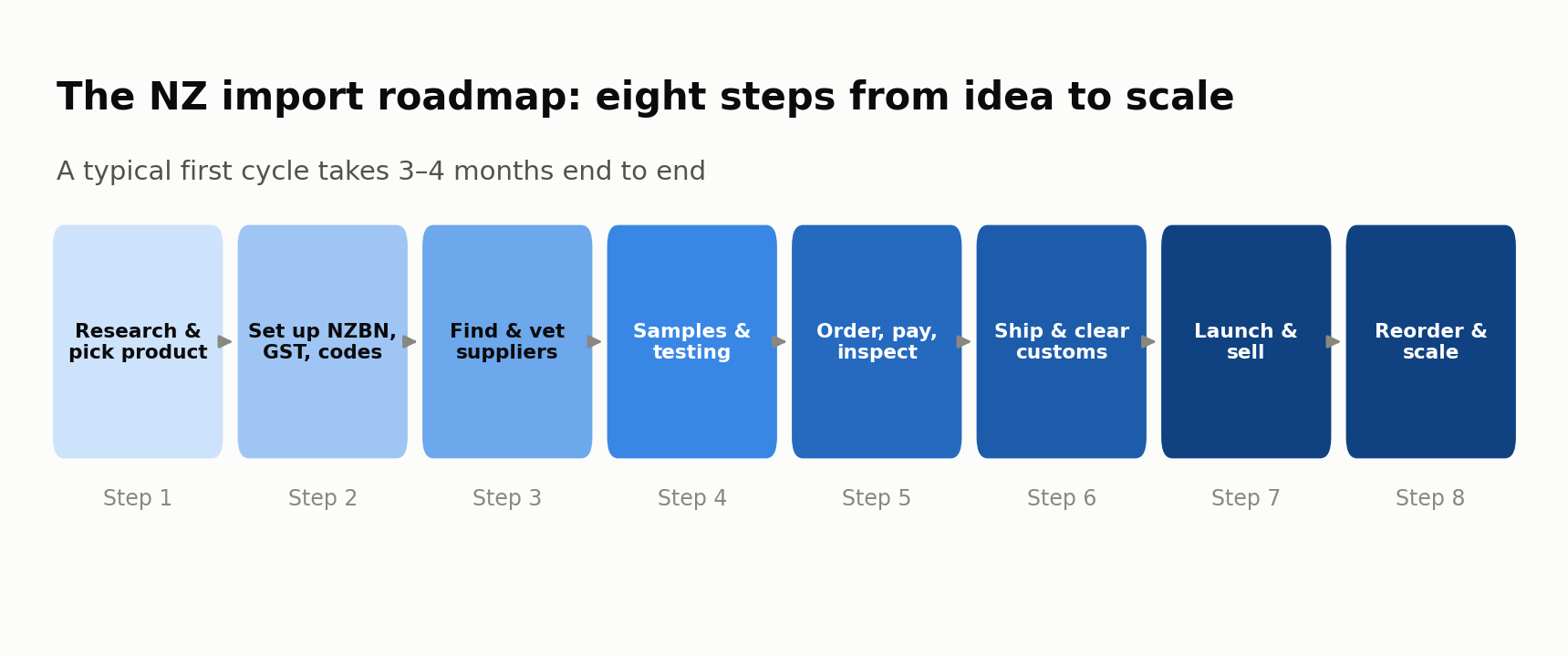
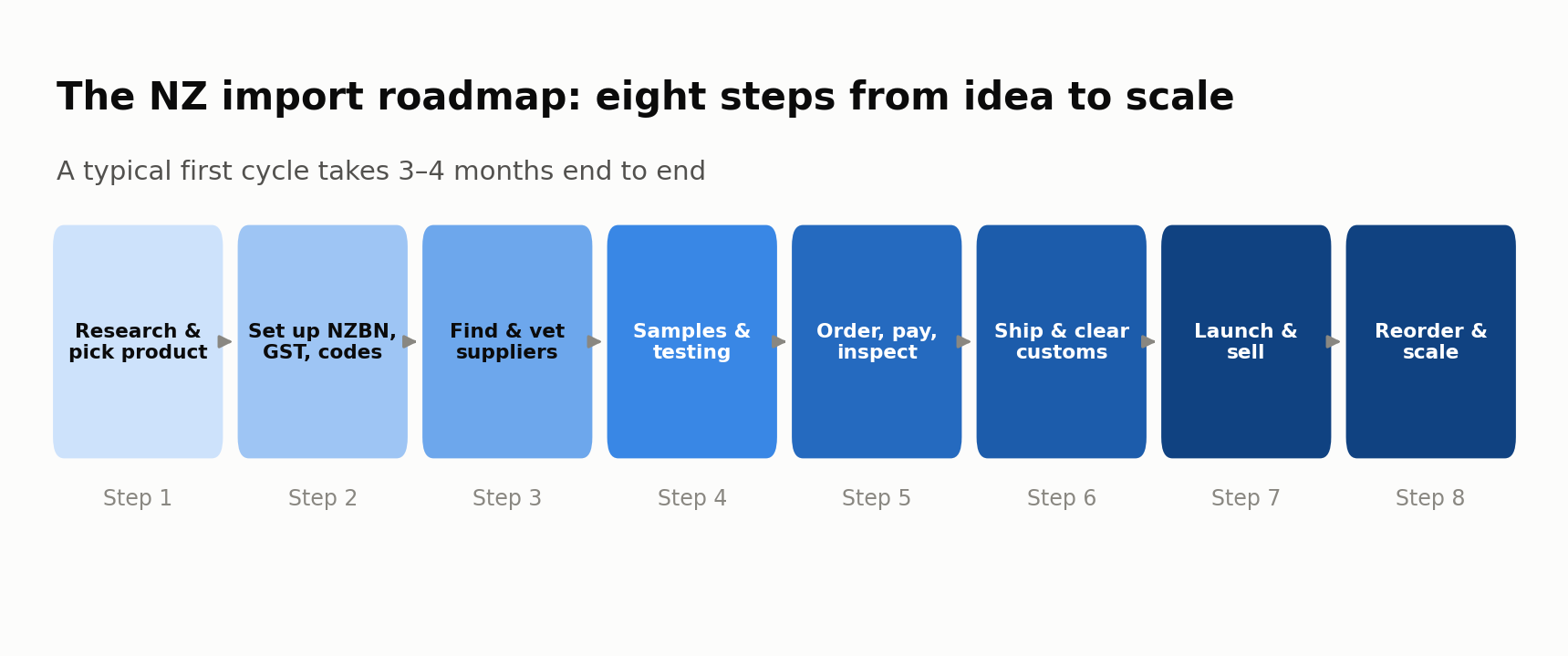
Figure: The import roadmap from business setup to first sale.
Stage 1: Set up the boring bits (one week)
You need three things before goods can move: an NZBN for your business, a decision on GST registration, and — for any shipment over NZ$1,000 — a Customs client code, applied for through Trade Single Window (TSW). GST registration is compulsory once your turnover passes NZ$60,000 in 12 months, but registering voluntarily earlier lets you claim back the 15% GST you'll pay on imports. We cover the exact process in a later post.
Stage 2: Choose a product with a real thesis
Don't start with whatever everyone else is selling. Pick a niche based on what you genuinely have: a social-media audience, a hobby you understand deeply, industry experience, or simply a well-researched shortlist. Check demand signals (Trade Me listings, Amazon best sellers, sales-estimation tools), and check the product isn't restricted or biosecurity-sensitive in NZ before you fall in love with it. Rule of thumb: to undercut an established branded product, you generally need to price at least 30% below it.
Stage 3: Find and vet suppliers
Alibaba and Global Sources put tens of thousands of manufacturers a message away, and both will even source suppliers for you free of charge. The hard part isn't finding suppliers — it's filtering out traders and scammers. Use platform verification filters, check ISO 9001 certification, demand a business licence, and never rely on a single supplier. Golden rule: if the price looks too good to be true, it is.
Stage 4: Samples, then a small first order
Order samples (expect to pay 20–50% over unit price, refundable against your first order — agree that up front). Test them hard: bend, stretch, use. Then negotiate a small trial order. Listed MOQs are almost always negotiable, and you should never pay more than 30% upfront — the unpaid 70% balance is your leverage for quality and on-time delivery.
Stage 5: Know your landed cost before you commit
Landed cost = product + freight + insurance + duty + GST + border levies + inspection + local costs. For most Chinese-origin goods with a Certificate of Origin, duty is 0% under the FTA; GST is 15% on (goods + shipping + insurance + any duty) and claimable if you're GST-registered. Since 1 April 2026, new consignment-based Goods Management Levies also apply at the border. If the numbers don't work on paper, they won't work in a container.
Stage 6: Ship, clear the border, and pass MPI
Use a freight forwarder and customs broker — never DIY container logistics. Budget realistic transit times: sea freight China→Auckland runs about 20–23 days port to port, and roughly 90 days total from placing a production order to stock in your warehouse. MPI biosecurity is the uniquely NZ hurdle: ISPM 15-treated pallets, clean containers, and extra scrutiny on timber, natural fibres and outdoor goods.
Stage 7: Sell — and diversify from day one
Trade Me is the obvious NZ starting channel, alongside your own Shopify store, Mighty Ape, Facebook Marketplace for testing, and Amazon Australia when you're ready to scale across the Tasman. Never build the business on one channel; platforms change rules without warning.
What it takes
A realistic minimum starting budget is around US$5,000 in product and costs — we break down the real numbers in an upcoming post. More important than money is process discipline: written specs, third-party inspections (about US$300 per order), and never paying 100% upfront. Beginners who follow the process outperform gamblers with triple the budget.
Key takeaways
- Margin is made in purchasing, not selling — buy at the source, not from local wholesalers.
- The NZ–China FTA gives 0% duty on virtually all Chinese-origin goods with a Certificate of Origin.
- Setup essentials: NZBN, a GST decision, and a Customs client code via TSW for shipments over NZ$1,000.
- Plan around 90 days from order to warehouse, and never pay a supplier 100% upfront.
Related: The 6-Step Import Process Every New Zealand Beginner Should Follow · How Much Money Do You Need to Start Importing to NZ? Real Numbers