
Building Your Own Brand on Imported Products in NZ
Turn generic imports into a brand Kiwis pay more for: low-cost product upgrades, packaging that sells, and the compliance duties NZ brand owners carry.
Two identical products come out of the same Chinese factory. One sells on Trade Me as a no-name gadget in a scuffed brown box with a photocopied manual. The other has a clean logo, packaging that looks like it belongs on a shelf, and instructions written in actual English. The second sells for 30–40% more — and it might have cost less than a dollar a unit extra to create. Building a brand on imported products isn't a marketing-budget game. It's a series of small, cheap upgrades most importers never bother with.
Why bother with a brand at all?
No-name trading is a fine way to start: calculated margins, quick tests, low commitment. But it's a treadmill — anyone can source the same item, so price is your only lever. A brand changes the equation. Customers pay more for perceived quality, reviews accrue to your name instead of a generic listing, and you build something sellable: an asset, not just stock. The progression we recommend is no-name to test demand, private label once a product proves itself, and your own developed products later, once trusted suppliers and steady sales exist.
The zero-to-low-cost upgrade playbook
You don't need custom tooling to differentiate. This exact sequence of paper-first upgrades has seeded full product catalogues:
- Change the colour. Often free or near-free at production time, and instantly separates your listing from every identical black version on the market.
- Upgrade one internal component. A small up-cost — a better speaker driver, a stronger hinge, a higher-grade battery cell — creates an honest quality claim competitors can't match without re-sourcing.
- Redesign the packaging. Clean, minimal, well-photographed. One standout idea we love: a "nutrition facts"-style specification panel on the box — instantly legible and memorable.
- Rewrite the manual in proper English. Translation and proofreading gigs on Fiverr start around US$5. Polished instructions read as quality, reduce support emails, and earn better marketplace reviews.
- Commission real product photos and a presentation PDF. Essential the moment you pitch retailers or wholesale customers.
Crucially, negotiate all of this on paper first: get costs and MOQs for each modification before sampling anything, and only sample once customer interest is confirmed. Ideas are free to price up; samples and stock are not.
For design work, use freelance designers on Upwork or Fiverr for a few hundred US dollars rather than the factory's in-house design department — factory designs tend to come out heavily Asian-styled for a market that isn't yours. And once you have packaging artwork, always print at the same printing factory every batch, supplying artwork files and Pantone codes; switch printers and your brand colour will visibly drift between production runs.
Match packaging spend to your channel
Here's a rule that saves real money: if you sell online-only, the customer never sees the box before buying — so don't gold-plate it. A white box, a sticker and a great listing photo do the job while your volumes are small. Full printed gift boxes need roughly 1,000-unit print runs, so treat them as a milestone for proven products. The calculus flips the moment you pitch physical retail: buyers for NZ chains and independents judge the box as much as the product, because their customers will. Nicer-packaged products get ranged; scrappy ones don't.
The NZ brand owner's obligations
Putting your name on a product changes your legal position, and Kiwi importers need to walk in with eyes open. Under the Consumer Guarantees Act, when the actual maker has no New Zealand presence, the importer is treated as the manufacturer — the guarantees sit with you. The Fair Trading Act means every claim on your packaging and listings must be accurate, and mandatory product safety standards apply to categories like toys. Electrical products need compliance under the Electricity (Safety) Regulations — declared articles require a Supplier Declaration of Conformity — and anything wireless needs Radio Spectrum Management compliance. None of this should scare you off; it's the same duty every NZ brand carries. It simply means your brand promise has to be backed by real quality control: tested samples, pre-shipment inspections, and suppliers who confirm compliance requirements point by point.
Protect the asset as it grows: register the trade mark, secure the domain and social handles early, and build your audience from day one. A brand with a few thousand engaged followers before launch can sell out its first shipment in a week — and every future product you source gets to launch to that same audience.
Key takeaways
- Small upgrades — colour, one better component, clean packaging, a properly written manual — lift perceived value far beyond their cost.
- Negotiate every modification on paper first; sample only after costs, MOQs and customer interest line up.
- Spend on packaging where it's seen: minimal for online-only, retail-grade the moment you pitch physical stores.
- As brand owner you carry the manufacturer's obligations under NZ law — back your name with real QC and compliance paperwork.
Related: OEM vs ODM vs Private Label: What They Mean and What They Cost, Where to Sell in NZ: Trade Me, Your Own Store, or Amazon Australia?

OEM vs ODM vs Private Label: What They Mean and What They Cost
ODM, OEM and private label decoded for NZ importers — real tooling costs, MOQ ladders, lead times and the no-capital OEM workaround.
Tooling for a full custom product can run US$8,000–50,000 before a single unit is made — and even the mould for a small plastic cover can cost US$2,000. That's the price of the letters "OEM". Meanwhile, "welcome OEM!" appears in half the supplier emails you'll ever receive, usually meaning nothing of the sort. Before you plan your product strategy, let's decode what ODM, OEM and private label actually mean, what each genuinely costs, and which one a New Zealand importer should start with.
ODM: off the rack
ODM — original design manufacturer — is the "open" model. The factory owns the design and the tooling; anyone can buy the product; you customise colours, logo and packaging only. This is the default mode for nearly everything on Alibaba and Global Sources.
The economics are why beginners should love it: no tooling investment, small MOQs, short lead times. The trade-off is exclusivity — your competitor can buy the identical item from the identical factory next week. Your edge has to come from selection, quality control, branding and service rather than the product itself.
OEM: your design, your risk
OEM — original equipment manufacturer — is the "closed" model: an exclusive design owned by you, the way Apple and Samsung own theirs. The upside is a genuinely unique product nobody can order from a catalogue. The downsides are heavy: tooling from US$2,000 for a simple cover to US$8,000–50,000 for a full product; up to 60 days to cut the tooling plus 40–60 days of manufacturing; and larger minimum quantities to justify the setup.
There's a quieter obstacle too. Most factories won't do real OEM development for a stranger. "OEM welcome" in a first email is sales talk; in practice factories develop custom products for customers with an established relationship — often on the order of US$100,000 of prior business. They want evidence you can sell before they commit engineering time.
One workaround exists if a supplier truly believes in your design: negotiate for the factory to fund the tooling itself, in exchange for you getting around 12 months' market exclusivity, after which they may sell the product to others. Expect them to want a sales guarantee in a separate exclusivity contract. Only take this deal on a product you genuinely believe in — a guarantee you can't meet is worse than no deal.
Two protections before you show anyone anything: sign an NDA before disclosing designs — without one, ideas walk. And if your design brushes against an existing patent, know that "the supplier changed it a bit" clears nothing. Slightly modified copies of registered designs are still infringements, and it's the importer who wears the lawsuit while the factory vanishes. For serious volume, have a patent lawyer clear the design.
Private label: the ladder in between
Private label is branding an ODM product as your own, and it scales as a ladder tied to volume:
- 5–50 pieces: accept the supplier's standard packaging. This is testing-the-waters territory.
- 100–500 pieces: request a neutral white box and add a printed colour sticker with your logo — stickers cost cents and look sharp.
- 500–1,000+ pieces: full custom-printed gift box. Colour print runs need roughly 1,000 units minimum because most Chinese printers won't run below ~800 boxes; under that, you can pay a premium for a short run.
Need one beautiful branded box early — say, to pitch a New Zealand retail buyer? Digital printing produces a one-off for up to about US$40 per piece. It'll have small imperfections, but it sells the concept without a print run.
Private label is where the margin is once volumes justify it: customers pay more for a perceived brand, and it's a step you can take with zero tooling risk. One production tip that saves later grief — always print your packaging at the same printing factory, supplying artwork files and Pantone codes, or you'll get visible colour drift between batches.
The right sequence for NZ importers
Start ODM with light private-label touches: proven product, sticker or white-box branding, your quality checks on top. Build sales history on Trade Me or your own store, build trust with one or two suppliers, and reinvest. Full custom packaging comes when a product earns a 1,000-unit order; OEM comes when you have proven demand, a trusted factory and the cash to survive a tooling bill and a four-month development runway. Skipping straight to OEM as a first-time importer means betting five figures on an unproven product with a factory you've never tested. Climb the ladder instead — every rung is profitable in its own right.
Key takeaways
- ODM (factory's design, anyone can buy) is the beginner's default: no tooling cost, low MOQs, fast lead times.
- Real OEM means US$2,000–50,000 tooling, months of lead time and a relationship most factories reserve for proven customers — though a factory-funded tooling deal with ~12 months' exclusivity is negotiable.
- Private label scales as a ladder: supplier packaging → white box + logo sticker → full printed gift box at roughly 1,000 units.
- Sign an NDA before sharing designs, and never trust "we changed the patented design a bit".
Related: Building Your Own Brand on Imported Products in NZ, MOQ Explained: How to Negotiate Smaller First Orders

Negotiation Tactics That Actually Work With Chinese Suppliers
The 20% counter, the double-quantity quote, 180-day price validity and more — field-tested tactics NZ importers can use in their next supplier email.
Take the supplier's quoted price, cut it by 20%, and send that back as your target. In roughly 80% of cases you won't get the full cut — but you will get a further reduction, typically around 5% off the original quote, simply because you asked in a structured way. That's the 20% counter, and it's the first move in a toolkit of tactics that work on real Chinese suppliers, in real email threads, without poisoning the relationship you'll depend on for years. Remember why this matters so much: margin is made in purchasing, not selling. Every dollar negotiated off your buy price drops straight to your bottom line.
The core price tactics
The 20% counter. As above. Quote received, minus 20%, presented politely as your target price "to make this product work in the New Zealand market". Expect to land around 5% below the original quote. It fails mainly when quantities are genuinely tiny.
Trial-order framing. Never negotiate a first order as a one-off. "This is a trial order — if it succeeds, larger orders follow" reframes your small volume as the start of a pipeline, which is the only story that justifies a factory sharpening its pencil.
The double/triple-quantity quote. Ask for pricing at two to three times your intended volume to expose the supplier's real floor, then ask them to honour that price on your smaller starter order with the full quantity promised at reorder. Factories need lines running; this works in most cases.
The mixed calculation. Buying four SKUs from one supplier, but only one is price-sensitive against competitors? Push the sensitive item's price down and let the supplier claw some of it back across the other three. Your competitive product stays sharp; the supplier's total stays acceptable; everyone signs.
The competing offer. Present a cheaper rival quote and ask for at least parity. If you genuinely have one, send it. If you don't, you may claim one exists — around 10% cheaper is credible — and you're under no obligation to show it. Suppliers do exactly the same in reverse.
Advance raw-material purchase. Before a reorder, when commodity prices are low, offer this trade: the supplier buys raw material now at today's prices, and in exchange you get a better price than last order. They may ask for a written order confirmation first — that's reasonable.
Lock the price down
A negotiated price you can't hold is worthless. Always demand stated validity on quotes: 90 days is standard, so ask for 180. Big retail buyers get twelve months or more. Without validity in writing, the price can move between your quote to a customer and your purchase order to the factory — and that gap comes out of your margin. Get validity onto every quotation and into your purchase-order terms.
Once a relationship matures, add the annual bonus agreement: agree a yearly turnover target with, say, a 5% rebate off the next order when it's hit, stepping up for higher thresholds. These conversations barely work by email — they're for phone calls at minimum, and ideally for a factory visit, where suppliers who've promised "best price, best service" to your face find it very hard to walk that back.
The relationship is the strategy
Here's what separates negotiators who get one good deal from importers who get a decade of them: six rules — mutual benefit, respect, fairness, trust, support, help. Squeeze every last cent from a supplier and you'll win the spreadsheet and lose the war: your order goes to the back of the queue, quality gets quietly value-engineered, and when you need an urgent favour — a rushed reorder before Chinese New Year, a rework at no charge — nobody picks up. Suppliers prioritise customers who are profitable and easy to deal with. Be firm on numbers, generous on everything else.
The most elegant tactic of all is what we call inception: framing your request as the supplier's own opportunity. A factory once refused to fund the roughly US$8,000 audit a European retail customer required — until the conversation reframed it: this standard is the entry ticket to every big retailer in that market; invest and you open doors far beyond one customer, and we'll refer you. He paid for it himself. When you can make your ask their win, you stop negotiating and start collaborating.
One caution to finish: a suspiciously low price is not a victory. Suppliers don't sell below cost — an impossible price means substituted materials, skipped testing or a scam. Negotiate hard toward a fair price, not a fantasy one.
Key takeaways
- Open with the 20% counter and trial-order framing; expect around 5% off the original quote in most negotiations.
- Use the double-quantity quote to find the real price floor and the mixed calculation across multi-SKU orders.
- Demand 180-day price validity in writing — an unlocked price silently eats the margin you just negotiated.
- Play the long game: fair, respectful buyers get better prices, priority production and rescue favours; cent-squeezers get the back of the queue.
Related: MOQ Explained: How to Negotiate Smaller First Orders, Handling Supplier Price Increases Without Losing Your Margin

MOQ Explained: How to Negotiate Smaller First Orders
Listed MOQs are almost always negotiable. Learn why the 1,000-piece minimum is usually a packaging issue — and the tactics that shrink it to 200.
That "MOQ: 1,000 pieces" line scaring you off a perfect product? In most cases it isn't a manufacturing requirement at all — it's a printing requirement. Most Chinese printing houses won't run colour gift boxes below roughly 800–1,000 units, so the factory quotes 1,000 as its minimum because that's the smallest batch of boxes it can buy. Change the packaging and the "immovable" MOQ often collapses to 200. Understanding what's really behind a minimum order quantity is the difference between walking away from good products and negotiating your way into them.
What MOQs actually mean
Listed MOQs on Alibaba and Global Sources are almost always negotiable, and sometimes barely connected to reality in either direction. A listing showing "MOQ: 9 units" usually just means nine pieces sitting in stock — the real production minimum is often 100+. A 1,000-piece MOQ usually traces back to the gift-box print run, not the assembly line. Factories set MOQs around three genuine constraints: raw material purchase minimums, the cost of setting up a production line for a small run, and packaging print minimums. Everything else is negotiating position.
The packaging workarounds
Since packaging drives so many MOQs, packaging is where you attack first:
- Accept a white box. Ask for the product in a plain neutral box and the MOQ frequently tumbles from 1,000 to around 200 pieces.
- Add a logo sticker. Colour stickers cost cents each and have tiny print minimums. A white box plus a sharp sticker looks perfectly respectable — especially if you sell online, where the customer never sees the box before buying.
- Pay a premium for a short print run. Some printers will do ~300 boxes at a higher per-unit price. On a first order, paying slightly more per box to cut your total risk by two-thirds is nearly always the right trade.
Full colour-printed private-label packaging is a milestone for your second or third order, once the product has proven itself — not an entry fee for your first.

Negotiating the quantity itself
Beyond packaging, three framing tactics consistently shrink minimums:
Trial-order framing. Always present your first order as exactly that: "This is a trial order — if it sells well, larger orders will follow." Factories tolerate thin margins on a small run to win a recurring customer. Every supplier knows the first order is an audition for both sides.
The double-quantity quote. Ask for pricing at two or three times the volume you actually intend to buy. That reveals the supplier's real price floor. Then ask them to hold that price for your smaller trial order, promising the full quantity on the reorder. It works more often than it should — factories need to keep production lines running.
Know the calendar. A factory heading into a quiet season, or hungry after Chinese New Year disruption, accepts smaller runs it would decline in peak season. Flexibility on timing is negotiating currency.
What you shouldn't do is grind a supplier to an MOQ so low the order is worthless to them. An order that loses the factory money gets deprioritised, delayed and quietly cost-cut. Aim for the smallest order that still works for both sides — the six-word summary of all good supplier negotiation.
The NZ maths: why smaller first orders are smart, not timid
For a New Zealand importer there's a genuine tension here. Smaller orders mean higher per-unit freight — 200 units shipped LCL at around US$38 per cubic metre into Auckland costs more per piece than a full container — and sea freight minimums bite harder on small consignments. Since April 2026, border levies are also charged per consignment, so five tiny shipments cost more in levies than one consolidated one.
But run the risk maths, not just the unit maths. A 200-unit first order that reveals a product flaw, a packaging problem or slow demand on Trade Me costs you a fifth as much tuition as a 1,000-unit mistake. Cash you didn't sink into excess stock is cash funding your second, better-negotiated order — which, with China-origin goods entering NZ at 0% duty under the China FTA (with a Certificate of Origin), scales cleanly once the product proves out. Pay the small-order premium once, deliberately, as the price of information.
Key takeaways
- Most large MOQs are printing minimums in disguise — a white box plus logo sticker often cuts 1,000 pieces to about 200.
- Frame every first order as a trial with bigger orders to follow, and use a double-quantity quote to uncover the real price floor.
- Never negotiate a supplier into an order that loses them money; the smallest order that works for both sides wins.
- Small first orders cost more per unit in freight and per-consignment levies — treat that premium as cheap insurance against a 1,000-unit mistake.
Related: Negotiation Tactics That Actually Work With Chinese Suppliers, OEM vs ODM vs Private Label: What They Mean and What They Cost
Ordering Samples the Right Way (and What to Test When They Arrive)
How NZ importers should order supplier samples: costs, courier tactics, the refund deal to lock in up front, and exactly what to test on arrival.
Expect to pay 20–50% more than the quoted unit price for a sample. That surcharge isn't the supplier gouging you — it's insurance against the "sample collectors" who order freebies from fifty factories and never buy anything. The good news: most suppliers will refund the sample cost against your first order. The catch: only if you agree it up front and remind them when the order lands. If you're sampling 30–40 products a year while hunting for winners, those refunds add up to real money. Here's the full playbook.
Agree the terms before anything ships
Your sample request should nail down, in writing: quantity; exact colour and specification; your delivery address; the agreement that sample cost is deducted from the first order; and the shipping arrangement. On shipping cost, there's a fair split most suppliers accept readily — they waive the sample charge, you pay the freight. Once a relationship is established, free samples become normal.
One firm rule: ship on the supplier's courier account, never your own. Chinese suppliers hold negotiated courier rates far below anything you can get retail from DHL or FedEx in New Zealand. And never give a supplier your own courier account number — accounts handed over this way have been used for other people's shipments.
The customs paperwork tactic
Ask the supplier to mark the invoice "samples of no commercial value" and to declare a sensibly reduced value. The key word is sensibly. A US$9 gadget declared at US$3 is plausible; a US$99 item declared at US$8 screams false declaration and invites exactly the customs attention you're trying to avoid. Remember the NZ side too: consignments at or under NZ$1,000 come in under the low-value goods regime (GST typically collected by the platform or supplier at sale, plus the small per-consignment levy introduced in April 2026), while anything over NZ$1,000 goes through full Customs entry. Keep sample shipments modest and correctly described, and they'll flow through without drama.
Two special cases: products with built-in lithium batteries — power banks, many Bluetooth devices — may be barred from airmail or restricted by couriers, so check before the supplier ships. And anything containing wood, plant fibre or other biosecurity-risk material can attract MPI's interest even as a sample; check the relevant Import Health Standard on mpi.govt.nz first.
When the box arrives: test like your worst customer
A sample's job is to disappoint you now, cheaply, rather than later across 1,000 units. So don't admire it — attack it.
- Visual inspection. Moulding marks, sharp edges, panel gaps, paint drips, packaging quality. Compare against the listing photos and the spec you agreed.
- Function test — hard. Use it the way a careless customer would. Bend it, stretch it, drop the packaging, run the battery flat, charge it with a cheap charger, click every button a hundred times.
- The confusion test. If you find it fiddly or unintuitive to operate, your customers will find it worse — and tell everyone on Trade Me about it. Confusing operation is a product defect even when nothing is broken.
- A second opinion. Hand it to a technically minded friend without any coaching and watch what they struggle with. Their honest reaction is free market research.
Document every flaw with photos and notes, send the list to the supplier, and state plainly that these points will be checked again at the pre-shipment inspection. That sentence does two jobs: it gets the issues fixed, and it tells the supplier you're a buyer who verifies.
When to pay for a lab
For most first orders, your own testing plus a third-party pre-shipment inspection is enough. But when the item is expensive, or your order will exceed roughly 500 pieces or US$2,000–3,000 in value, professional lab testing earns its keep. A few hundred US dollars buys a proper report on safety, materials and function — which you send back to the supplier as a to-fix list before production starts. It matters more the moment you sell beyond your own website: retail and wholesale buyers in New Zealand will ask for test reports, and for electrical goods you'll need the compliance paperwork regardless. Roughly 95% of small-scale importers never do formal testing; being in the 5% is a competitive moat as much as a safety measure.
Keep every sample you approve. That golden sample becomes the reference standard your inspection company compares mass production against — the physical definition of "what I ordered".
Key takeaways
- Samples cost 20–50% over unit price; always agree up front that the cost is refunded against your first order — and claim it.
- Ship on the supplier's courier account, mark invoices "samples of no commercial value" with a plausible declared value, and check lithium-battery and biosecurity rules first.
- Test brutally: visual, function, durability and the confusion test — then send the defect list and promise it will be re-checked at inspection.
- Lab-test when orders top ~500 units or US$2,000–3,000, and keep the approved golden sample as your production reference.
Related: First Contact: Writing Supplier Emails That Get Serious Replies, Third-Party Inspections and AQL: Quality Control Before Goods Ship

First Contact: Writing Supplier Emails That Get Serious Replies
A proven first-email template for Chinese suppliers, plus the tactics that get NZ importers real quotes instead of a PDF catalogue and silence.
A busy Chinese sales rep might open eighty enquiry emails a day. Most get skimmed, half-answered or replied to with a generic PDF catalogue. Whether yours gets a proper quote — with real prices, MOQs and lead times — comes down to how you write it. After years of supplier correspondence, we can tell you the difference between a reply-magnet and a deleted email is about ten minutes of structure.
The template that works
Here's the skeleton we use for every first contact, adapted for a New Zealand buyer:
Dear [name],
My name is [your name] and I am the buyer for [Your Company] Ltd. We are an online retailer operating in New Zealand. Website: [URL].
I am writing to enquire about model number [exact model from the listing]. Could you please provide:
- Unit price based on [quantity] pieces (FOB)
- Minimum order quantity
- Available certification and test reports (e.g. CE, RoHS, FCC)
- Production lead time
- Available colours
- Payment terms
Kind regards, [name, company, website]
Every element is doing a job. The company introduction positions you as a professional operation, not a hobbyist. The exact model number forces a specific answer. And the bullet list is the single most important trick in the email: suppliers answer bullets. Bury six questions in a paragraph and you'll get answers to two of them; list them and you'll usually get all six.
Never reveal you're a beginner
Rule one of first contact: never tell a supplier this is your first import. The moment they know, you're flagged as high-effort and low-volume — prices firm up, attention drops, and you lose negotiating standing you'll never fully recover. You don't need to lie extravagantly. "We are expanding our product range" is true from your first day of trading. A simple website, a company email address (not Gmail), and confident phrasing complete the picture. This costs almost nothing and changes how every subsequent message is treated.
Why we ask for CE and RoHS — even in New Zealand
CE is a European mark and FCC is American; neither is an NZ legal requirement. We ask anyway, for two reasons. First, they're powerful quality signals: a supplier already producing to CE/RoHS standard for European customers has passed testing that most junk-tier factories can't. Second, the answer exposes competence — a supplier who has never heard of any certification framework should be eliminated in round one.
For your actual NZ obligations, translate to local equivalents before ordering: declared electrical articles need a Supplier Declaration of Conformity under the Electricity (Safety) Regulations, and anything wireless or Bluetooth must meet Radio Spectrum Management (RSM) requirements. Put your compliance requirements in this first email and require the supplier to confirm each point explicitly — suppliers habitually reply with a price spreadsheet and quietly ignore compliance questions. If they dodge twice, call them and pin it down, or move on.
Handling the catalogue-dump reply
Even with a perfect email, some suppliers will ignore your specific question and fire back a 40-page PDF catalogue. Don't take it personally — many sales reps simply don't read whole emails. Reply politely, re-state the exact model number, and re-paste your bullet list: "Thank you for the catalogue. To confirm, I need pricing for model X-200 specifically. Please answer each point below." Suppliers who still can't engage with a direct question after two attempts are telling you what communication mid-order will look like. Believe them, and drop them.
Contact many, file everything
Never rely on one supplier. Send your enquiry to at least five to ten candidates from Alibaba and Global Sources — response quality is itself a vetting filter, and multiple quotes are your only real negotiating leverage later. From the very first reply, keep one folder per supplier holding their quotation, company profile, certificates and your correspondence. In three months, when you're comparing quotes or chasing a claim, that email from week one will matter. Importers who can't find their own paperwork lose disputes they should win.
A note on tone: keep it professional, specific and warm. Suppliers prioritise customers who look profitable and easy to deal with. You're not just requesting prices — you're auditioning as a customer worth having.
Key takeaways
- Introduce your company confidently, quote the exact model number, and put every question in a bullet list — suppliers answer bullets, not paragraphs.
- Never reveal you're a first-time importer; position yourself as an established NZ retailer expanding its range.
- Ask about CE/RoHS as quality signals, but confirm your real NZ requirements (SDoC for electrical, RSM for wireless) point by point before ordering.
- Contact five to ten suppliers, treat reply quality as a vetting filter, and file every document per supplier from day one.
Related: How to Vet a Chinese Supplier Before Sending a Cent, Ordering Samples the Right Way (and What to Test When They Arrive)

Trading Company or Factory? How to Tell Who You're Really Dealing With
Middlemen add 10–30% to your buy price. Learn the name trick, profile checks and video-call test that reveal whether your "factory" really makes anything.
"Ningbo Better Lighting Co." and "Zhejiang Ningbo Better Lighting Co." sound almost identical — but one is probably a trading company and the other probably owns a factory. That single naming detail has saved us from paying middleman margins more times than any other check. Margin is made in purchasing, not selling: every percentage point a hidden middleman skims off your buy price is profit you'll never get back at the selling end. Here's how to work out who you're really dealing with.
Why it matters (and when it doesn't)
A trading company buys from factories and resells to you with a margin on top — often the very markup you went direct to China to avoid. Worse, a trader has no control over production quality, timing or specifications; they're forwarding your emails to a factory you'll never meet.
But let's be fair: not all traders are villains. Many genuine factories don't hold an export licence and legitimately sell through an affiliated trading company that handles export documents for a small percentage. Some traders add real value — consolidating small orders, quality-checking, communicating in good English. The problem isn't traders existing; it's traders pretending to be manufacturers so they can charge factory-direct expectations at middleman prices. Your job is to know the truth, then decide.
The company-name convention
Chinese company registrations follow a pattern that leaks the answer. Trading companies typically register with their hometown city in the name; manufacturers tend to register with the province. So "Ningbo Better Lighting Co." (city) leans trader, while "Zhejiang Ningbo Better Lighting Co." (province first) leans manufacturer. It's a probability signal, not proof — but it tells you which follow-up questions to push hardest.
Profile checks that expose middlemen
- Category spread. A "factory" whose storefront sells LED torches, yoga mats, USB cables and garden furniture makes none of them. Real manufacturers are specialists — a factory is a building full of machines tooled for one product family.
- Management standards. Factories invest in ISO 9001 (and increasingly BSCI); traders almost never do. No standard listed → assume trader. Standard listed → request the certificate and check the company name and address on it match. A mismatch means they're showing you someone else's factory.
- Registered capital vs claimed turnover. 50,000 RMB registered capital claiming US$50M turnover doesn't add up. Neither does massive turnover with a staff of 15. A properly organised factory usually runs 200+ people across workers, sales, engineers and management.
- The business licence. Ask for a copy. Yes, it's in Chinese — but outright refusal to provide it is the tell, and the registered scope of business can be translated in seconds.
The tests a trader can't pass
Paper checks narrow the field; two active tests settle it.
The customised sample. Ask for a small modification to the product — a different colour, your logo moulded in, a spec tweak — and a sample of it. A factory controls its own line and can do this; a trader has to go begging to the real manufacturer, and the delay, cost and excuses give the game away.
The live factory video call. Ask your contact to video-call you from the production floor and walk the line while you watch. Manufacturers are proud to show off; middlemen suddenly have "no availability". Back it up with a phone call: ask about annual capacity, main customers, which machines they run, what their engineers are working on. Vague answers to concrete factory questions mean there's no factory.
One more trick from the negotiation table: if one supplier's quote is well above the others, show them the cheaper quotes and ask why. We've seen this produce the remarkably honest reply, "Actually, we are a trading company." Cheaper isn't automatically better, though — sometimes a higher price reflects better materials or genuine certifications, which is exactly why you ask rather than assume.
What to do with the answer
If they're a factory: proceed to full vetting, samples and negotiation. If they're a trader who admits it and adds value you need — export licence, consolidation, communication — you can still work with them, with eyes open and prices benchmarked against factory-direct quotes. If they're a trader who lied about being a factory: walk. Someone who deceives you about their own identity before the first order will not become more honest after your deposit lands.
For a New Zealand importer running orders from 10,000 km away, the supplier relationship is your entire supply chain. Knowing exactly who is on the other end of it isn't paranoia — it's the foundation everything else sits on.
Key takeaways
- City name = likely trader; province name = likely manufacturer. Use it to direct your questioning, not as final proof.
- Specialist product range, ISO 9001, plausible capital/turnover/headcount and a willingly shared business licence all point to a real factory.
- A customised sample plus a live video walk-through of the production line is the pairing no middleman can fake.
- An honest trading company with an export licence can be legitimate — a trader pretending to be a factory never is.
Related: How to Vet a Chinese Supplier Before Sending a Cent, Sourcing Agents: When to Use One, What They Cost, What to Expect

How to Vet a Chinese Supplier Before Sending a Cent
A practical vetting checklist for NZ importers: platform filters, certificate checks, the video-call test and the red flags that mean walk away.
The most expensive email a new importer ever sends is the one transferring a deposit to a supplier they never checked. From Auckland or Christchurch you can't drop in to see the factory, so your protection is a vetting process — a series of cheap, fast checks that scammers and fake factories can't pass. Run every prospective supplier through this before a single dollar leaves your account.
Start with the platform filters
On Alibaba, filter for Gold Supplier, Onsite Check and Assessed Supplier together. Each represents money and scrutiny a scammer won't invest in. On Global Sources, look at the verified data: exhibiting history and named customers. This first pass eliminates most of the worst candidates in thirty seconds. It can also exclude some genuine young factories, so if results are thin, relax one filter at a time — but tighten your later checks to compensate.
Read the profile like a detective
A supplier's own profile leaks the truth if you know where to look:
- Management standards. No ISO 9001 or BSCI listed? Skip them. If it is listed, ask for the certificate and check the company name and address on it match the supplier you're talking to. Middlemen don't invest in management standards.
- Category breadth. A "manufacturer" selling everything from kitchenware to power tools to phone cases is a trading company. Real factories are specialists.
- Numbers that don't add up. Registered capital of 50,000 RMB against claimed turnover of US$50 million is fantasy. Huge turnover with 15 staff is equally fishy.
- Scale and age. A well-organised factory typically runs 200+ employees — say 160 workers, 30 sales staff, 10 engineers, 10 managers. Factories younger than about five years deserve extra caution.
- The company-name convention. Trading companies usually register with their hometown in the name; manufacturers use the province. We cover this trick in detail in its own post.

Ask for the documents
Now move to active verification. Email the supplier and request: a copy of their business licence (it will be in Chinese — the refusal to send it is the signal, not the content); their factory standard certificates (ISO 9001 at minimum); which third-party test laboratories they use; factory photos or a company presentation; and their customer list and main export markets.
Two things to watch in the answers. First, be cautious if they only ever work with Chinese test and inspection companies — you want suppliers accustomed to international third-party scrutiny. Second, look at their markets. If they already supply Australia, the UK, Germany or the US, they've likely passed the audits and testing those markets demand, which is a strong proxy that they can meet New Zealand requirements too — things like an SDoC for declared electrical articles and Radio Spectrum Management compliance for wireless products. If they've never exported to a first-world market, expect to educate them at your own risk.
Send a short vendor profile form asking for production capacity, worker/engineer counts, main customers, certifications and turnover. Professional suppliers fill it in without fuss.
The killer test
Two checks are almost impossible for a middleman to fake. First, ask them to produce a customised sample — something they don't have sitting on a shelf. Second, ask for a video call where they walk you through the factory live. A genuine manufacturer will happily show off the production line; a trader will stall, excuse and deflect. Follow up with a phone call and grill them on customers, annual capacity and certifications. You're building a gut feeling as much as a file of evidence.
And watch the communication itself. If replies are slow, fragmented or ignore half your questions at the enquiry stage — when they're trying to win your business — it will be worse mid-order when they already have your deposit. Eliminate the weakest communicators early.
The walk-away triggers
Some findings end the conversation immediately: a demand for 100% payment up front (legitimate suppliers accept a 30% deposit or a letter of credit); prices dramatically below every other quote; odd payment requests such as a personal bank account or Western Union; certificates whose company details don't match. The golden rule is old but reliable — if it looks too good to be true, it is. There are thousands of suppliers; never be so invested in one that you ignore a red flag.
One nuance: "trading company" is not automatically a death sentence. Many genuine factories lack an export licence and legitimately sell through an affiliated trader who handles export paperwork for a small margin. The crime isn't being a trader — it's pretending to be a factory.
Key takeaways
- Stack the free platform filters first, then verify certificates, licences and customer lists yourself — matching names and addresses on every document.
- A customised sample plus a live factory video call is the test middlemen can't fake.
- Poor communication at enquiry stage only gets worse after you've paid — cut slow repliers early.
- 100% upfront payment demands, implausible prices and mismatched certificates are instant walk-away triggers.
Related: Trading Company or Factory? How to Tell Who You're Really Dealing With, Import Scams and Red Flags: How Kiwis Get Burned (and How Not To)
Alibaba vs Global Sources: Which Platform Should Kiwi Importers Use?
Alibaba or Global Sources for NZ importers? We compare supplier quality, scam risk and free sourcing services so you pick the right platform first.
Type "bluetooth speaker" into Alibaba and you'll get tens of thousands of listings — factories, trading companies, middlemen and outright scammers all mixed together. Type the same thing into Global Sources and you'll get a fraction of the results, but a noticeably higher hit rate of professional, export-ready suppliers. Which one should a New Zealand importer actually use? Our answer: both — but for different jobs.
Alibaba: the biggest haystack in the world
Alibaba is the largest B2B supplier database on the planet, and for sheer choice nothing touches it. If a product exists, someone on Alibaba sells it. You can filter by product, by supplier type and — a trick most beginners miss — by Chinese province, which matters because manufacturing in China clusters hard by region. Consumer electronics sit in Guangdong, tools and outdoor gear in Zhejiang, and roughly 95% of the world's electrical multi-boxes come out of one city, Cixi, near Ningbo.
The catch is quality control of the listings themselves. Millions of entries include duplicates, traders posing as factories, and scammers. Alibaba's paid badges help you filter: Gold Supplier (a paid membership), Onsite Check (the physical operation has been verified) and Assessed Supplier (a third party has audited machinery, staff and certifications). Scammers and pure middlemen rarely invest in all three, so stacking those filters clears out most of the rubbish — at the cost of also hiding some legitimate newer factories. If your search comes back thin, relax the filters one step at a time.
Global Sources: smaller, sharper, more professional
Global Sources is the Hong Kong-based competitor. It's smaller, but in our experience the suppliers on it write better English, respond faster, follow up more professionally and include far fewer scammers. Supplier profiles carry verified data such as existing customers and trade-show exhibiting history — genuinely useful when you're vetting from 10,000 km away in Auckland.
Where Global Sources really earns its place is the free extras:
- Monthly sourcing e-magazines — hand-picked suppliers and trending products by category, delivered free. A painless way to watch what's coming before it hits Trade Me.
- Buyer support library and expert Q&A — practical answers on sourcing problems.
- Private sourcing events — tell them your product and quality requirements and they'll pre-screen around 20 matching suppliers and set up a meet-and-match session.
- Country sourcing reports — for when you want to manufacture outside China.
The free service almost nobody uses
Here's the part that surprises most new importers: both platforms will source suppliers on your behalf, free. Describe what you need — product, specs, target price, quantity — and their teams will match you with vetted suppliers. You're a buyer; you are the product these platforms sell to their supplier members, so they're motivated to help you spend. Before you pay a sourcing agent 5–30% on top of factory prices, use the free option.
What about AliExpress?
AliExpress is Alibaba's retail arm — single units and small lots at prices roughly 30% above true factory bulk cost. It's not where you'll place a serious order, but it's brilliant for testing the waters: order 5–20 units of a product, list them on Trade Me or Facebook Marketplace, and find out whether Kiwis actually buy before you commit to hundreds. One caveat for shipments into NZ: anything at or under NZ$1,000 will have 15% GST added at checkout by GST-registered overseas platforms, so build that into your test maths.
Our recommendation for NZ importers
Use them as a pair. Start your product research on Alibaba because the depth is unbeatable — you'll see the full range of specs, price points and MOQs in one afternoon. Then run the same search on Global Sources and shortlist suppliers from both, weighting Global Sources suppliers slightly higher on trust. Contact five to ten suppliers minimum; never build your business on one platform or one supplier.
Whichever platform a supplier comes from, the listing is only an introduction. The real work — checking whether they're a factory or a trader, verifying certificates, testing communication speed — happens in the vetting stage, and the platform badge is merely your first filter, not your last.
Key takeaways
- Alibaba wins on sheer selection; use its Gold Supplier, Onsite Check and Assessed Supplier filters together to remove most scammers and middlemen.
- Global Sources has fewer suppliers but better English, more professionals and verified customer data — plus free sourcing events and e-magazines.
- Both platforms will find and vet suppliers for you free of charge — use that before paying a sourcing agent.
- Use AliExpress only for small test orders (remember the 15% GST added at checkout under NZ$1,000), never for bulk buying.
Related: How to Vet a Chinese Supplier Before Sending a Cent, Trading Company or Factory? How to Tell Who You're Really Dealing With

Landed Cost 101: The Formula That Decides Whether You Make Money
The landed-cost formula for NZ importers — every line item from FOB price to GST and levies, with a full worked example in real numbers.
Two importers buy the identical product at the identical US$10 FOB price. One makes 40% net margin; the other quietly loses money on every unit and doesn't discover it for six months. The difference is a single spreadsheet: the landed-cost calculation. It's the least glamorous document in importing and the most decisive — calculating your costs appropriately genuinely makes or breaks your import.
Landed cost = every dollar it takes to get one unit from the factory floor to your NZ warehouse, ready to sell. Not the supplier's price. Not the price plus freight. Everything.
The quick rule of thumb
For a low-duty destination like New Zealand, a useful first-pass estimate is supplier's FOB price + 20–30% ≈ landed cost. It's good enough for shortlisting ideas on your shopping list — and nowhere near good enough for a purchase order. Before real money moves, you build the full sheet and triple-confirm each line with the actual provider: forwarder, broker, insurer, platform.
Every line item, NZ edition
- Product cost (FOB): the supplier's quoted price, which under FOB terms includes delivery to the Chinese port. Include any export-packaging extras.
- Sea/air freight: mid-2026 indicative rates China→NZ: a 20ft container US$2,250–2,750; 40ft US$4,455–5,445; LCL around US$38/cbm; air freight about US$4.00/kg for larger lots; courier around US$6.71/kg door to door. Rates are volatile — quote, don't assume.
- Insurance: the standard is about 1% of product value. Cheap, and not the line to skip.
- Customs duty: 0% on virtually all Chinese-origin goods with a Certificate of Origin under the NZ–China FTA — make sure the supplier provides it. Otherwise most goods are duty-free anyway, with roughly 5–10% on categories like textiles, clothing and footwear. Confirm your HS code on tariff-finder.govt.nz.
- GST: 15%, calculated on (goods value + shipping + insurance + any duty). If you're GST-registered you claim it back — treat it as cash flow, not cost, but you still have to fund it at the border.
- Goods Management Levies: the new consignment-based border levies from 1 April 2026. Small on any one shipment, but per-consignment — one more reason to consolidate. Check customs.govt.nz for current rates on high-value entries.
- Broker and forwarder fees: customs entry lodgement, handling, documentation. Ask for the all-in quote.
- Inspection: ~US$300 for a third-party pre-shipment inspection. Non-negotiable on real orders.
- Testing and licence fees: lab testing where relevant (a few hundred US dollars), plus the fees suppliers never mention — Bluetooth licensing and Sisvel (MP3/MP4) royalties are the importer's cost, and skipping them risks customs holds or claims from licence holders.
- Domestic costs: transport from the port, storage, fulfilment, and your selling channel's fees when you calculate final profitability.
The worked example
Let's land 1,000 Bluetooth speakers in Auckland. FOB price US$10 each = US$10,000.
- Freight: ~3 cbm shipped LCL at ~US$38/cbm ≈ US$115 with minimums
- Insurance at 1% of product value: US$100
- Duty with NZCFTA Certificate of Origin: US$0
- Inspection: US$300
- Broker, entry and Goods Management Levy: allow roughly US$150 (confirm with your broker)
- Subtotal: ~US$10,665 — about US$10.67 per unit
- GST: 15% on (goods + shipping + insurance + duty) ≈ US$1,532 — funded at the border, claimed back if GST-registered
So a GST-registered importer's true landed cost is around US$10.67/unit — roughly FOB + 7%, well inside the rule of thumb, because this product is small, light and duty-free. Convert to NZ dollars at the day's rate, add local delivery and storage, then selling costs: on a marketplace, budget several percent for fulfilment and payment fees. If that unit retails at, say, NZ$49–59 in NZ, the margin story is obvious — and it was visible before ordering, which is the entire point.

Now rerun the same sheet for a bulky item — a US$20 product at 0.1 cbm each — and watch freight alone add US$3.80+ per unit before GST. Same formula, opposite verdict. That's the formula doing its job: killing bad products on paper instead of in your garage.
One sheet per product, forever
Make the landed-cost sheet a permanent habit: one per product, updated with actual invoiced figures once the shipment lands, so every reorder starts from real numbers rather than estimates. Costs drift — freight moves ~19% in a month during 2026, suppliers nudge prices, levies get reviewed — and your sheet is where drift becomes visible before it becomes losses.
Key takeaways
- Landed cost = FOB + freight + insurance + duty + GST + levies + fees + inspection — every line, triple-confirmed with the actual provider.
- FOB + 20–30% is a shortlist estimate only; for NZ with FTA duty at 0%, small light products often land far below that.
- GST (15% on goods + shipping + insurance + duty) is claimable if registered — cash flow, not cost, but budget to fund it.
- Watch the silent killers: freight on bulky items, licence royalties, and per-consignment levies on fragmented shipments.
Related: How Much Money Do You Need to Start Importing to NZ? Real Numbers, NZ Import Duty and the China FTA: How a Certificate of Origin Saves You Money
Validate Before You Buy: Testing Product Demand Without Spending a Dollar
How to test demand for an import product before ordering — free validation checks, NZ market signals, and the failure story that proves why.
A margin of US$39 per unit collapsed to US$1.50. That's what happened to an entrepreneur who built a genuinely good portable speaker, priced it under the big brands, and skipped proper validation. He discovered too late that five-plus big brands already owned the niche and buyers wanted brands, not bargains; that retailers were launching lookalikes with bigger marketing budgets; that shipping his heavy product actually cost US$50–60 a unit; and that plug compatibility added another US$10. His crowdfunding campaign reached 6% of target. Every one of those discoveries was available for free, before he spent a cent — he just didn't go looking.
Validation is the unglamorous step between "great idea" and "purchase order". Here's how to do it without spending a dollar.
Check the demand signals
You're trying to answer one question: do enough people already buy this, at a price that leaves you margin?
- Amazon and eBay: use best-seller ranks and review counts as a proxy for volume. Hundreds of recent reviews = proven demand (and proven competition). A free look with a tool like Jungle Scout's estimates sharpens the picture.
- Trade Me: search your product. How many listings? How do "sold" prices compare with what you'd need to charge? A category with steady sales and only tired, badly photographed listings is an opportunity; forty sharp sellers is a warning.
- Google Trends: is interest rising, seasonal, or dying? NZ-filtered data is thin for small niches, so check Australia and worldwide too — trends reach us on a lag, which works in your favour.
- Social hashtags: search the product on Instagram and TikTok. Post volume, engagement and growth tell you whether a wave is building or has broken.
Check the competition honestly
Confirm few or no NZ sellers carry the product — and if some do, that you can be meaningfully different (quality, bundle, packaging, service), not just marginally cheaper. Remember the benchmark from earlier in this series: against an established branded product you generally need to be at least 30% cheaper to pull buyers. And watch for the speaker trap: in brand-loyal categories, price barely matters at all. If the top players are household names, be somewhere else.
Ask real people — carefully
Float the idea in forums and Facebook groups where your target customers gather — NZ buy/sell groups, hobby communities, subreddit niches — without revealing so much that you hand the idea to a competitor. Ask about problems, not products: "what annoys you about X?" surfaces demand and improvement ideas at once. If you have any social following, tease the product and count genuine "where can I buy this?" replies. One importer built 8,000 followers in two months before launch and turned that audience into roughly 100 sales in week one — the validation and the launch marketing were the same activity.
Run the numbers before the order, not after
The speaker failure was a costing failure as much as a demand one. Before any money moves, build the landed-cost picture: manufacturing price, freight (deadly on heavy or bulky items), insurance, duty (0% for most Chinese-origin goods with a Certificate of Origin), 15% GST, border levies, selling fees — and the sneaky extras like licence royalties or country-specific adaptations. Then triple-confirm each figure with the actual provider: the forwarder for freight, the broker for border costs, the platform for fees. Estimates compound; one "roughly" per line item and your margin is fiction.
The (nearly) free physical test
Strictly-zero-dollar validation gets you a long way, but if a product survives every check above, there's a cheap final exam: order a handful of units — via a sample order or a small AliExpress purchase — and list them on Trade Me and Facebook Marketplace at your intended price. Real listings, real buyers, real objections. Selling five units at full price teaches you more than fifty spreadsheet rows: which photos work, what questions buyers ask, whether the price holds. If the test units sell easily, you order with confidence. If they sit there, you've just saved yourself a NZ$8,000 lesson for the price of a takeaway.
Kill ideas cheerfully
The goal of validation isn't to confirm your idea — it's to try to kill it. Most ideas should die at this stage; that's the system working. Your shopping-list spreadsheet has more candidates, and the discipline of killing weak ideas cheaply is exactly what lets you bet properly on the strong one that survives.
Key takeaways
- Validate demand free: marketplace ranks and reviews, Trade Me sold prices, Google Trends, and social hashtags.
- Check competition honestly — you need ~30% under a branded rival, and brand-loyal niches are unwinnable on price.
- Triple-confirm every cost line with the actual provider before ordering; estimates killed the speaker launch.
- Finish with a tiny real-world test on Trade Me or Facebook Marketplace before committing to a production order.
Related: How to Find the Right Product to Import: A Practical Framework, Landed Cost 101: The Formula That Decides Whether You Make Money

Products You Should NOT Import into New Zealand (and Why)
The product categories NZ beginners should avoid — licensed goods, biosecurity risks, anti-dumping items, patent copies and margin killers.
A pallet of garden furniture sits in a transitional facility in Auckland while MPI decides whether the untreated wooden packaging gets fumigated or destroyed — at the importer's expense, either way. The product was fine; the category choice was the mistake. Knowing what not to import is worth as much as any winning product idea, so before you fall in love with something on Alibaba, run it against this list.
Licensed and regulated categories: leave them alone
Some categories demand licences, registrations or approvals that are genuinely hard for a beginner to obtain — and getting it wrong isn't a slap on the wrist, it's seized goods:
- Foods, drinks and supplements
- Anything gas-related
- Vehicles
- Animals and animal products
- Weapons and firearms-related items
- Hazardous materials and chemicals
Could you eventually import protein powder compliantly? Perhaps. Should your first import be a product where MPI, food-safety rules and labelling law all apply at once? No. There are thousands of products where the compliance burden is a fraction of this.
Biosecurity-sensitive goods: MPI will find them
New Zealand's biosecurity regime is among the strictest on earth, and MPI has the power to inspect, treat, hold, destroy or order re-export of risky goods — with the bill landed on you. High-risk categories include timber and wooden furniture, natural fibres, outdoor and garden products, gym equipment with rubber or plant-based padding, stone and clay items, anything contaminated with soil, and used goods of almost any kind (which attract heavy scrutiny). These aren't banned — plenty of established importers handle them profitably — but they demand Import Health Standard checks on mpi.govt.nz before ordering, and they're a poor place to learn. And regardless of product: any wooden pallets or crates must be ISPM 15 treated and stamped, or your whole consignment inherits the problem.
Anti-dumping and high-duty items: the maths is rigged against you
Most goods enter NZ duty-free, and Chinese-origin goods are almost all 0% under the FTA — but not everything. Selected categories such as textiles, clothing and footwear still carry duty around 5–10%, and anti-dumping duties exist on certain products (MBIE's trade remedies list is the place to check). Internationally, the recurring anti-dumping families are batteries, solar components and steel products. The rule is simple: a punitive rate either kills your margin outright or signals a protected local industry with more lawyers than you. Check the Working Tariff Document and tariff-finder.govt.nz before committing — if the rate is ugly, move on.
Copies and patent-infringing products: the supplier's fairy tale
"Don't worry, we changed the design a bit." You will hear this, and it is false comfort: slightly modifying a patented or registered design does not clear it. The cautionary tale is the flood of bladeless-fan copies that hit the market after Dyson's original — retailers who stocked them paid fines, pulled stock, and were named in the press, while the factories that supplied them vanished from the conversation. As the importer of record, the liability is yours, not the supplier's. Branded fakes are even worse — that's not importing, it's an offence. Genuinely different components and function are generally safe; for anything serious, a patent search is cheaper than a lawsuit.
Margin killers: legal, but a bad idea
- Big, heavy, low-value items. Washing machines, furniture, large appliances: freight is charged on volume and weight, and a US$20 product occupying half a cubic metre never recovers. Small, light, durable wins.
- Brand-dominated categories. In some niches — premium audio is the classic — buyers want the brand and barely look at price. We've seen a genuinely good independent speaker die in exactly this trap. If the category's buyers are logo-loyal, your 30%-cheaper product still loses.
- Fragile and returns-prone goods. Under NZ consumer law, when the manufacturer has no NZ presence, the importer effectively carries the manufacturer's obligations. A 10% breakage rate is your problem, in your margin, on your doorstep.
- Electrical and wireless products — until you're ready. Not forbidden, but mains-powered goods fall under NZ electrical safety regulations (declared articles need a supplier declaration of conformity) and anything with Bluetooth or Wi-Fi needs Radio Spectrum Management compliance. Also note lithium batteries bring shipping restrictions — some couriers won't even airfreight your samples. Do these categories deliberately, later, with budget for compliance — not as a first product.
The five-minute pre-check that saves thousands
Before shortlisting any product: HS code on tariff-finder.govt.nz (duty and anti-dumping), Import Health Standards on mpi.govt.nz (biosecurity), Product Safety Standards under the Fair Trading Act (toys, cots, bikes and others have mandatory standards), and a quick patent/brand sanity check. Five minutes per product. Do it before the supplier conversation, not after the deposit.
Key takeaways
- Avoid licensed categories (food, supplements, gas, weapons) and used or plant/soil-associated goods as a beginner.
- Check tariff-finder.govt.nz and MBIE trade remedies — anti-dumping or high-duty items are automatic passes.
- "We changed the patented design a bit" is a fairy tale; as importer of record, the liability is yours.
- Skip heavy low-value goods, logo-loyal categories and electrical/wireless products until you're resourced for them.
Related: MPI Biosecurity: Getting Through the NZ Border Without Nasty Surprises, NZ Product Compliance: Electrical, Wireless, Toys and Safety Standards

12 Places to Find Winning Product Ideas Before Anyone Else in NZ
Twelve practical sources of import product ideas — from Kickstarter and Taobao to trade-fair exhibitor lists — before they reach NZ shelves.
A Danish gadget was funding wildly on Kickstarter while a single seller had a near-identical unit on Amazon for US$149 — and the same product sat on Alibaba with an estimated manufacturing cost under US$10. Whoever spotted that gap first didn't need genius; they needed a habit of looking in the right places. New Zealand's distance is actually an advantage here: trends often land on our shelves months after they've peaked overseas, which means a Kiwi importer watching the right sources sees products coming before local competitors do.
Here are the twelve places we keep watching, roughly in order of effort.
The armchair sources
1. Amazon Best Sellers. Free, updated hourly, sliced by category. You're not looking to copy the top item — that ship has sailed — you're reading which categories are heating up and what customer reviews complain about (every complaint is an improvement idea).
2. eBay trend signals. Watch what's suddenly selling in volume, but treat it as a signal, not a shopping list — the saturated majority is exactly what you don't copy.
3. Trade Me itself. Study what's listed heavily, what sells fast, and — more usefully — what NZ buyers clearly want but can only get via slow overseas shipping. That gap is your local opening.
4. Kickstarter and crowdfunding sites. Products funding on Kickstarter usually aren't on Amazon (or in NZ) yet — a genuine window to source a similar (non-infringing) product, improve it, and launch while the category is fresh. The US$149-listing example above came from exactly this watch.
5. 100+ niche newsletters. Subscribe to gadget and trend sites — The Gadget Flow, Engadget, Wired, CNET, PCMag and dozens of smaller ones — using a separate email address created just for this. Product ideas get delivered to you daily, free.
6. Kadaza. A curated directory of the top websites per category — the fastest way to find the trend blogs for whatever niche you're exploring, from home gadgets to pet gear.
The supplier-side sources
7. Global Sources e-magazines and Top Products. Free monthly sourcing e-magazines with hand-picked suppliers and trending products per category — you're seeing what factories are pushing before it reaches Western marketplaces. Alibaba's curated selection pages serve the same purpose.
8. Taobao. China's giant domestic marketplace. Run it through auto-translate and browse: products made for Chinese consumers are frequently tomorrow's Western trend — bubble tea was visible in Asia years before it exploded elsewhere. Almost no NZ competitor is looking here.
9. Trade fairs — even from your couch. The Canton Fair and the Hong Kong shows are the single most efficient idea source if you can travel (a trip can pay for itself), with peak editions in April and October. Can't fly? Every fair publishes a full exhibitor list online — mine it for products and supplier contacts without leaving Tauranga.
The real-world sources
10. Shops, malls and supermarkets. Photograph interesting products wherever you are — you're always working. What's in a Sydney or Singapore mall today may have zero NZ presence.
11. Travel. The classic: spot a product thriving in a foreign market that's absent at home. Every overseas holiday is a research trip if you keep your eyes open.
12. Research tools. When a candidate emerges, pressure-test it: Jungle Scout estimates Amazon sales volumes and fees via a browser extension; CashCowPro ranks the most profitable Amazon niches including factory cost and freight estimates. Amazon data isn't NZ data, but it's the best public proxy for product demand you'll find, and it's where you check whether a "winner" actually sells.
Turning sightings into a shortlist
Ideas are cheap; the system matters. Keep one running spreadsheet — photo, source link, estimated factory price, target NZ price, rough margin, notes — and add everything that passes the sniff test. Once a fortnight, rank the list and take the top one or two ideas into proper validation: demand checks, competition checks, and the landed-cost maths we cover later in this series. Then check the boring-but-vital stuff early — NZ regulations, biosecurity sensitivity, and whether the thing is small and light enough to freight economically.
Do this for three months and you'll have a deeper product pipeline than most established NZ importers, who mostly reorder what they sold last year.
Key takeaways
- Watch overseas sources — Kickstarter, Amazon, Taobao, supplier e-magazines — because trends reach NZ late, and that lag is your window.
- Free beats paid at the idea stage: newsletters, exhibitor lists and best-seller pages cost nothing.
- Use tools like Jungle Scout to check that an idea actually sells before you spend a dollar.
- Funnel everything into one shopping-list spreadsheet and validate only the top-ranked ideas.
Related: How to Find the Right Product to Import: A Practical Framework, Validate Before You Buy: Testing Product Demand Without Spending a Dollar

How to Find the Right Product to Import: A Practical Framework
A practical framework for choosing your first import product — match the niche to your own advantages, then apply hard filter rules.
The most expensive sentence in importing is "this product sells really well for other people." Chasing what's already saturated is the classic first-timer move: you arrive last, with the least buying power, into a market where a dozen NZ sellers already offer the identical item — and the only lever left is price. There's a better way to choose, and it starts with an honest look at yourself rather than at best-seller lists.
Start with your situation, not the product
The right first product is different for different people. Work out which of these scenarios is yours:
- You have money but no idea. Capital doesn't excuse you from needing a product thesis. Slow down; work the research process like everyone else. A funded gamble is still a gamble.
- You're on a tight budget. Good news: you're at the same starting line as everyone else. Even a first product that isn't a killer usually returns the investment and teaches you the entire process — which is worth more than the margin.
- You have a social-media following. This is a genuine unfair advantage. Pick a product that fits the audience: 50,000 fitness or outdoors followers points at yoga mats, gym accessories, drink bottles, backpacks, camping gear. One importer we know built 8,000 followers across platforms in two months before launch and sold around 100 units in the first week from social alone. Then extend the range within the same audience — yoga mat buyers want more exercise gear, not a vacuum cleaner.
- You have a passion category. If you live and breathe fishing, coffee or cycling, you already know what a better product looks like and what to tell the supplier to improve. That's product-development instinct money can't buy.
- You have industry experience. Sell what you can answer customer questions about. The ex-electrician importing tool accessories will out-serve a generalist every time.
- None of the above. Fine — build the list. Write down your interests, hobbies and household frustrations; subscribe to niche newsletters; collect ten or more product ideas; then research demand for each (Trade Me, Amazon, eBay, sales-estimation tools like Jungle Scout, and what local shops stock) and work down the list one by one.
Then apply the hard filters
Whatever the scenario spits out, every candidate product has to survive these filters:
- Regulation check first. Is it restricted, licensed or biosecurity-sensitive in NZ? Check the tariff position on tariff-finder.govt.nz and MPI's Import Health Standards before you fall in love with it. Anything electrical or wireless carries compliance obligations; foods, supplements and the like are a licensing minefield best left alone at the start.
- Logistics sanity. Transport can kill margin on heavy or bulky items — freight is charged on volume and weight, not value. A product that's small, light, durable and unbreakable is a beginner's best friend.
- Competition reality. If the majority already sells it, don't start there. And note a hard number: to pull buyers off an established branded product, you generally need to price at least 30% below it. If that 30% doesn't leave you margin, walk away.
- Brand-dominated categories. Some niches are price-insensitive because buyers want the brand — premium audio is a classic. We've watched a well-made, well-priced portable speaker fail because buyers in that category simply wanted the logo. Respect that.
- The margin maths. Estimate manufacturing cost, freight, duty (0% on most Chinese-origin goods under the FTA with a Certificate of Origin), 15% GST, levies, selling fees — then see what profit remains at a realistic NZ price. If it only works at an optimistic price, it doesn't work.
Differentiate — even a little
You don't need to invent something new. The most reliable path is a proven product made meaningfully better: a nicer colour range, a sensible accessory bundle, cleaner packaging, a properly written English manual, better internal components for a few cents more. These "boring" upgrades cost little, most can be negotiated on paper with the supplier before you ever order, and they're exactly what lifts you out of the identical-item price war. Being early matters too: find a product before it's everywhere in NZ and lock in a good supplier relationship, and later arrivals have to come through you or start from scratch.
Make it a system, not a moment
Product selection isn't a one-off decision — it's a habit. Keep a running "shopping list" spreadsheet of ideas with photos, links, target prices and rough margin notes. Add to it constantly; cull ruthlessly; take the top idea through validation (next in this series) before any money moves. Your second and third products will come off this list faster than your first.
Key takeaways
- Choose your niche from your own advantages — audience, passion, or industry knowledge — not from best-seller lists.
- Filter every idea: NZ regulations first, then logistics weight/bulk, competition, and honest margin maths.
- You need to price roughly 30% below an established branded rival to compete — if that kills margin, move on.
- Differentiate cheaply: colours, bundles, packaging and manuals beat inventing something new.
Related: 12 Places to Find Winning Product Ideas Before Anyone Else in NZ, Validate Before You Buy: Testing Product Demand Without Spending a Dollar

Setting Up Right: NZBN, GST Registration and Your Customs Client Code
The three pieces of admin every NZ importer needs — NZBN, the GST registration decision, and a Customs client code via TSW — explained simply.
Here's a mistake we see constantly: a first shipment worth NZ$4,000 arrives at Auckland, and only then does the importer discover they need a Customs client code to clear it — while storage charges tick up daily at the port. The whole setup that would have prevented it takes a few hours, costs almost nothing, and can be done from your couch. Let's get you sorted before your goods are on the water.
There are three pieces of admin that matter: your NZBN, your GST position, and your Customs client code. Take them in that order.
1. Get your NZBN (and choose your structure)
Every NZ business gets a New Zealand Business Number. If you register a company, an NZBN is issued automatically; sole traders can apply for one free. Which structure should you choose? That's a conversation for your accountant, but the practical import angle is this: a company keeps the business's liabilities separate from your personal assets, which matters more for importers than for many other businesses — under NZ consumer law, when the overseas manufacturer has no NZ presence, you effectively carry the manufacturer's responsibilities for the products you bring in. Start as you mean to continue: separate bank account, and every invoice, payment record and supplier email filed from day one. You will need that email from four months ago; everyone always does.
2. Make the GST decision deliberately
GST registration is compulsory once your turnover exceeds NZ$60,000 in any 12-month period. Below that, it's voluntary — and this is where importers differ from most small businesses. When your goods cross the border, Customs collects 15% GST calculated on the value of the goods plus shipping, insurance and any duty. If you're GST-registered, you claim that import GST back in your GST return. If you're not, it's simply a cost.
So should you register early? For most people planning a genuine import business: yes. On a NZ$10,000 landed shipment, that's roughly NZ$1,500 of GST back in your pocket rather than baked into your costs. The trade-offs: you must charge 15% GST on your NZ sales, and you take on filing obligations. If you're doing a one-off toe-dip with a few hundred dollars of stock, staying unregistered is defensible; if you're building a business, register.
One 2026 note: the new Goods Management Levies that replaced the old border fees from 1 April apply to all importers per consignment, GST-registered or not — even small low-value consignments attract a levy of a couple of dollars plus GST. There's no registration status that makes border levies disappear.
3. Get your Customs client code before you ship
For any consignment worth more than NZ$1,000, NZ Customs requires the importer to have a client code — a unique identifier for you or your company — and the shipment also needs a supplier code identifying the overseas supplier. You apply through Trade Single Window (TSW), Customs' online portal, and you'll need your NZBN and identification documents to hand. In practice, your customs broker can apply on your behalf and will usually sort the supplier code at the same time; if you have a broker lined up (you should — see our roadmap post), just ask them.
Do this before your first shipment leaves China, not when it lands. A missing client code doesn't stop goods arriving; it stops them clearing, and delays at the wharf cost real money.
The supporting cast
While you're in setup mode, three more things worth lining up:
- A customs broker and freight forwarder. The broker lodges your import entries through TSW; the forwarder moves the goods. Get both relationships established before you order.
- Accounting software that handles GST returns — reconciling import GST manually gets old fast.
- A document system. One folder per supplier (quotes, certificates, licences), one folder per order (PO, invoice, packing list, Bill of Lading, inspection report). Customs and IRD can both come asking; tidy importers have boring audits.
What this all costs
Almost nothing, which is why there's no excuse: NZBN registration is free, GST registration is free, the TSW client code application is free. Company incorporation costs a modest fee. Compare that with one day of container storage charges plus a rebooked delivery because your paperwork wasn't ready, and setup is the best-value work you'll do this month. For current specifics and forms, go straight to the sources: customs.govt.nz for client codes and levies, ird.govt.nz for GST, and business.govt.nz for structure guidance.
Key takeaways
- Get your NZBN, then decide GST registration deliberately — registered importers claim back the 15% import GST.
- GST registration is compulsory past NZ$60,000 turnover in 12 months; voluntary before that, and usually worthwhile for a real import business.
- Shipments over NZ$1,000 need a Customs client code (via TSW) and a supplier code — arrange them before goods ship, ideally through your broker.
- Set up document discipline from day one: one folder per supplier, one per order.
Related: NZ Customs Clearance Step by Step: TSW, Entries and Client Codes, GST on Imports: The $1,000 Threshold Explained for 2026

How Much Money Do You Need to Start Importing to NZ? Real Numbers
Real numbers for starting an NZ import business — what a sensible first budget looks like, where every dollar goes, and how to start smaller.
You don't need NZ$50,000 and a container. A sensible minimum to do this properly — real production order, inspection, freight, compliance and a buffer — is about US$5,000, which is somewhere in the NZ$8,000–9,000 range depending on the exchange rate on the day. You can test the waters with far less, and we'll show you how, but let's start with what a genuine first import actually costs, line by line.
The benchmark: what US$10,000 of product can return
First, why bother? Here's a worked benchmark we use often: an importer puts US$10,000 into 1,000 Bluetooth speakers at US$10 each. After freight, insurance and border costs, the landed cost comes to roughly US$13 a unit; add fulfilment and selling costs and you're all-in around US$16. At a US$49 retail price, that's a US$33 margin per unit — about US$33,000 gross profit potential on a US$10,000 product investment. Not every product performs like that, and selling 1,000 units takes real marketing work. But it shows why the maths of direct importing is worth learning: the margin is created at the buying stage.
Where a realistic first budget goes

Here's the anatomy of a ~US$5,000 starter budget for a compact, unregulated product:
- Product (50–60%): your actual order — say 300–500 units of something with a US$5–8 unit cost. This is the engine; everything else protects it.
- Samples (2–4%): expect to pay 20–50% above unit price per sample, plus courier. Always agree that sample costs are refunded against your first order.
- Freight and insurance (8–15%): LCL sea freight to Auckland runs around US$38/cbm in mid-2026; insurance is about 1% of product value. Small, dense products keep this tiny; bulky ones blow it out.
- Border costs: GST at 15% on (goods + shipping + insurance + any duty) — cash you front, but claimable if you're GST-registered. Duty is 0% on most Chinese-origin goods with a Certificate of Origin. Add the new consignment-based Goods Management Levies and your broker's clearance fee.
- Third-party inspection (~US$300): non-negotiable on any first order over ~US$2,000. It's the cheapest insurance in this industry.
- Compliance/testing (0–10%): product-dependent. A silicone kitchen gadget needs little; anything electrical or wireless needs proper attention (and budget) for NZ safety and radio-spectrum requirements.
- Buffer (10–15%): for the freight surcharge, the extra courier bill, the thing you didn't foresee. There's always a thing.
What's deliberately not in the budget: paying 100% upfront (never), air-freighting your main order (margins evaporate at up to 20x sea cost), and fancy branded packaging on order one — a neutral box with a logo sticker costs cents and does the job below roughly 500 units.
Can you start with less? Yes — here's the ladder
- Under NZ$500: buy 5–20 units of a product via AliExpress or similar and test demand on Trade Me or Facebook Marketplace. Prices run roughly 30% above true factory bulk cost, and quality is a lottery — but you're buying market data, not margin.
- NZ$1,000–3,000: a small trial production order. MOQs are almost always negotiable — the classic move is accepting a plain white box instead of a printed gift box, which can drop a 1,000-piece MOQ to around 200 pieces, because the 1,000 figure is usually a printing constraint, not a production one.
- NZ$8,000+: the full process — proper order, inspection, LCL shipment, real per-unit economics. This is where the benchmark maths above starts to apply.
Whatever the level, frame it to suppliers as "a first trial order — if successful, larger orders follow." It's true, and it gets you better terms.
The cash-flow reality nobody mentions
Your money is tied up for a while: 30% deposit at order, 70% on inspection pass, GST and levies at the border, and roughly 90 days from order to sellable stock. Then sales revenue trickles in over weeks or months. Budget for living with that cycle at least twice before the business self-funds — undercapitalisation kills more import ventures than bad products do.
Key takeaways
- A proper first import needs about US$5,000 (roughly NZ$8,000–9,000); a demand test needs under NZ$500.
- Product should be 50–60% of budget; never skip the ~US$300 inspection or the 10–15% buffer.
- Import GST (15%) is claimable if you're GST-registered — it's cash flow, not a true cost.
- Negotiate MOQs down (white-box trick), pay only 30% upfront, and keep enough cash for the 90-day cycle.
Related: Landed Cost 101: The Formula That Decides Whether You Make Money, Setting Up Right: NZBN, GST Registration and Your Customs Client Code
The 6-Step Import Process Every New Zealand Beginner Should Follow
The six-step process NZ importers should follow every time — from tariff checks to inspection — plus the real 90-day order timeline.
Roughly 90 days. That's how long it takes, on average, from placing a production order in China to having stock sitting in your New Zealand warehouse. Beginners who don't know that number promise customers stock "next month", plan a Christmas promotion in October, and learn the hard way. The 90 days is just one output of a repeatable six-step process — the same one we run every idea through, whether it's a NZ$2,000 trial or a full container.
Run every product through these six steps, in order. Skipping a step is where the expensive mistakes live.
Step 1: Check the regulatory ground first
Before anything else, find your product's Harmonized System (HS) tariff code — it determines duty rate, any restrictions, and whether anti-dumping duties apply. For NZ, check the Working Tariff Document and tariff-finder.govt.nz; the good news is most goods enter duty-free, and Chinese-origin goods are almost all 0% under the NZ–China FTA with a Certificate of Origin. While you're at it, check MPI's Import Health Standards for biosecurity requirements, and MBIE for any trade-remedy (anti-dumping) measures. Ten minutes here can save you from a product that's uneconomic or effectively blocked at the border.
Step 2: Find your product
Product selection deserves its own posts (and gets them later in this series), but the short version: pick a niche you have an edge in — audience, passion, or professional knowledge — and differentiate on quality, bundles, colours or packaging rather than copying whatever saturates Trade Me already.
Step 3: Find a supplier
The most exciting and the most difficult step. Alibaba and Global Sources are your main hunting grounds; both will even match you with vetted suppliers free of charge. Contact multiple suppliers — never rely on one — and filter hard: verified status, ISO 9001, plausible company profile, responsive communication. If a supplier's replies are slow and fragmented at enquiry stage, they'll be worse mid-order.
Step 4: Calculate all duties, taxes and costs
Build a landed-cost sheet before committing. Rule of thumb: supplier's FOB price plus 20–30% gets you close to landed cost in a low-duty country like NZ — but verify every line: freight, insurance (about 1% of product value), GST at 15% on (goods + shipping + insurance + any duty), the new Goods Management Levies, and forwarder and broker fees. If you're GST-registered, the import GST comes back to you. Triple-confirm each figure with the actual provider rather than guessing.
Step 5: Engage a freight forwarder and customs broker
Never DIY container logistics. A forwarder books the freight and handles documents; a broker lodges your customs entry through Trade Single Window. Your supplier will usually have forwarder contacts — get that quote as a benchmark, then compare with an NZ-based forwarder. Couriers (DHL, FedEx and friends) are for samples and small urgent lots only; at scale their volumetric pricing eats margin.
Step 6: Monitor the order and inspect before it ships
Small orders get deprioritised in factory queues, so check in weekly. Then, before the goods leave China, book a third-party pre-shipment inspection — around US$300. Time it for when about 80% of production is complete. If defects show up, the supplier will agree to rework — always — because you haven't paid the 70% balance yet. Which brings us to the iron rule that underpins the whole process: never pay 100% upfront. Thirty percent deposit, seventy percent after the inspection passes.
The 90-day timeline, broken down

Here's where the time actually goes on a standard sea-freight order:
- Order placement and admin clarification: ~5 days
- Raw material purchase by the factory: 20–30 days
- Production arrangement and queueing: ~10 days
- Production through to shipment: 5–10 days
- Sea transit to NZ: China→Auckland is around 20–23 days port to port; allow ~30 with handling
- Customs clearance, MPI checks and inland transport: 5–10 days
Plan promotions, cash flow and reorder points around this cycle. Reorders are faster — typically about half the original lead time, since the factory already holds your specs — but Chinese New Year and October's Golden Week can add weeks if you order at the wrong moment.
Key takeaways
- Always run the six steps in order: regulations → product → supplier → costs → logistics partners → monitoring and inspection.
- Check the HS code, tariff-finder.govt.nz and MPI requirements before you commit to any product.
- Budget ~90 days from production order to NZ warehouse, and plan promotions accordingly.
- Pay 30% deposit, inspect at 80% production for ~US$300, and release the 70% balance only when the report is clean.
Related: How to Start an Import Business in New Zealand in 2026: The Complete Roadmap, Landed Cost 101: The Formula That Decides Whether You Make Money
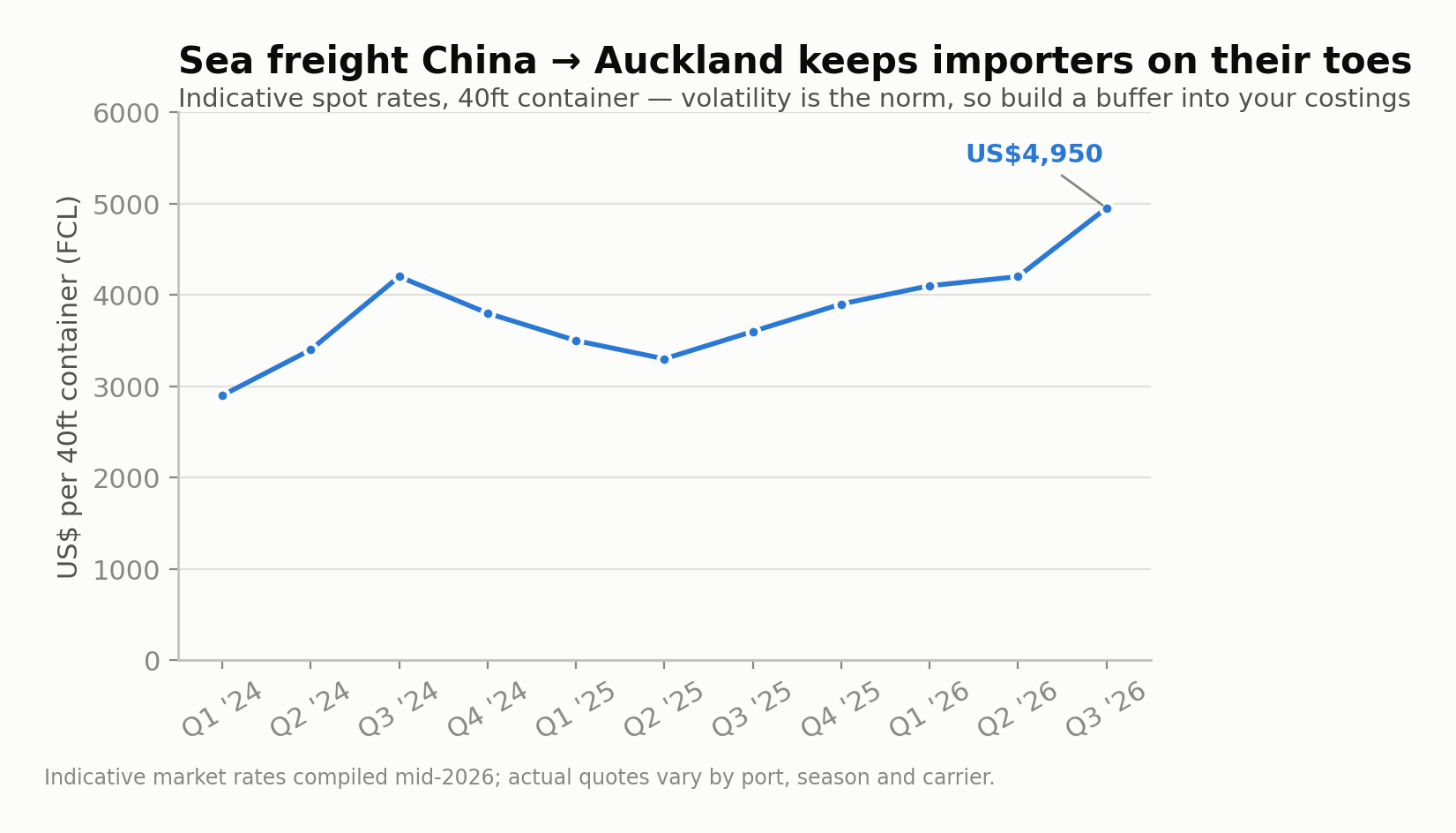
Why 2026 Is the Right Time for Kiwis to Start Importing
FTA duty at 0%, transparent new border levies and accessible freight rates — why 2026 stacks up well for new NZ importers.
Sea freight from China to Auckland is sitting around US$2,250–2,750 for a 20-foot container in mid-2026, LCL space is going for roughly US$38 per cubic metre, and a certificate of paper — literally one document — takes the duty on most Chinese-origin goods to zero. If you've been waiting on the sidelines wondering when the conditions favour a first-time importer, this is what favourable looks like.
We're not going to pretend importing is a licence to print money. But several things have lined up in 2026 that genuinely lower the barrier for New Zealanders, and it's worth understanding each one.
Freight is affordable — but watch the volatility
The chart below shows why timing matters. Rates on the China–NZ trade lane have seen swings of around 19% month over month during 2026, which sounds alarming until you realise what it means in practice: per-unit freight on a well-chosen product is small enough that even a bad month rarely breaks the business case. Ship 1,000 compact units in three cubic metres of LCL at ~US$38/cbm and your freight bill is barely over US$100 — cents per unit.
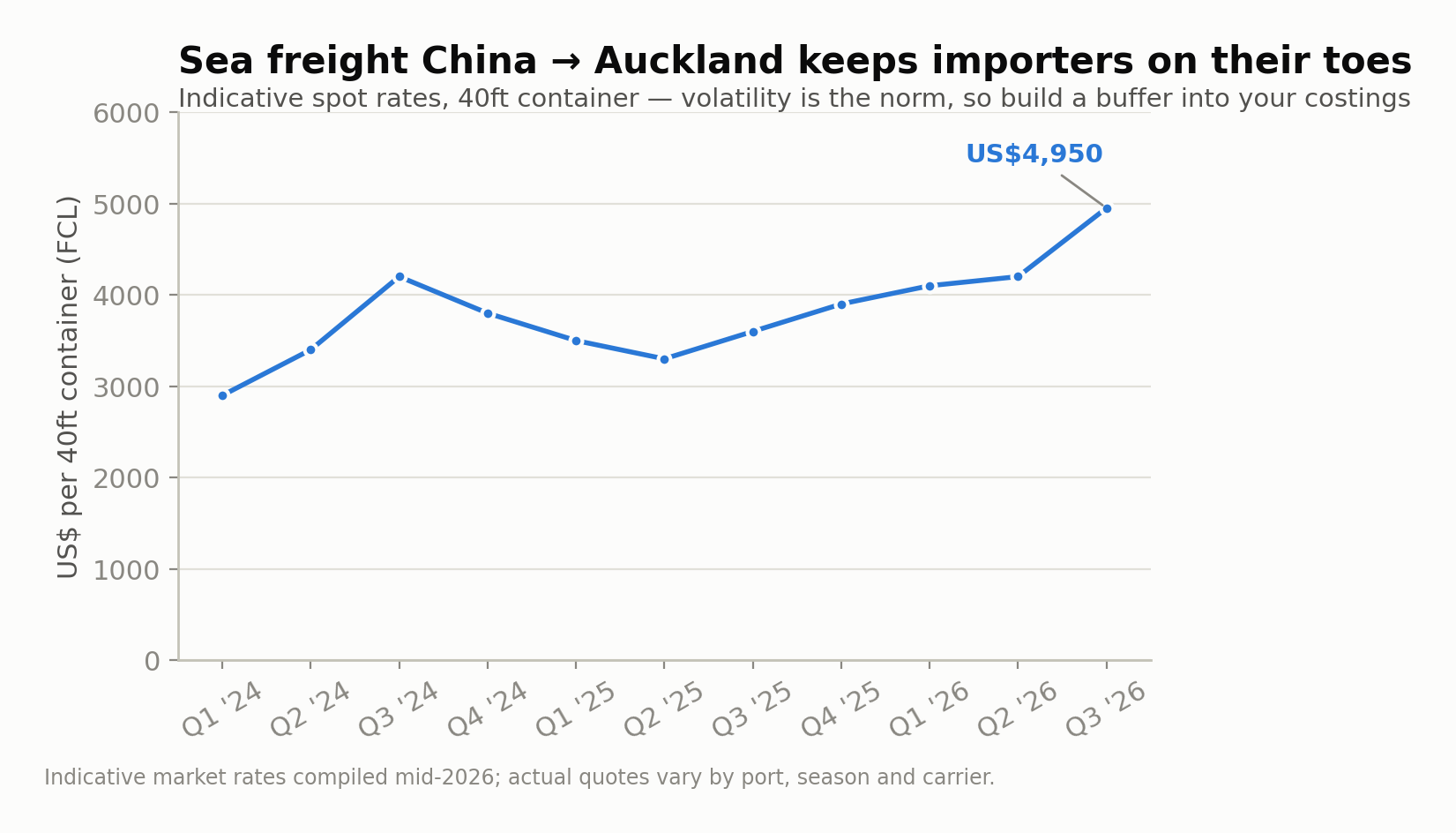
The lesson isn't "rates are cheap forever." It's that freight is now a manageable, quotable line item — get quotes from a forwarder before you order, and always benchmark against the quote from your supplier's own forwarder.
The China FTA does the heavy lifting
Under the NZ–China FTA, virtually all Chinese-origin goods enter New Zealand at 0% duty — you just need the supplier to provide a Certificate of Origin. Most other goods enter NZ duty-free anyway; only selected categories such as textiles, clothing, footwear and some processed foods carry duty of roughly 5–10%. Compare that with importers in protectionist markets who lose double-digit percentages at the border before they've sold a thing. Add the FTAs with ASEAN/Australia, CPTPP members, Korea, the UK and the EU, and NZ is one of the friendliest borders in the developed world for a small importer.
The new levies made border costs predictable
From 1 April 2026, the old Import Entry Transaction Fee and biosecurity levy were replaced by consignment-based Goods Management Levies. On low-value consignments (NZ$1,000 or less) you're looking at around NZ$2.21 by air or NZ$2.09 by sea per consignment, plus GST; higher-value consignments pay separate air/sea rates covering both Customs and MPI, invoiced per entry. Two practical consequences: first, border charges are now transparent and easy to model into a landed-cost sheet. Second, because charging is per consignment, consolidating orders into fewer, larger shipments now directly saves money — a habit that also gets you better freight rates.
Suppliers want small buyers like you
Fifteen years ago, factories courted container-load customers only. Today, Chinese suppliers are structurally open to small businesses and small quantities, and platforms make them searchable: Alibaba is the biggest database, and Global Sources offers verified suppliers, monthly sourcing e-magazines and even free supplier-matching services where you describe your product and they line up pre-screened factories. The infrastructure that once required a Hong Kong buying office now fits in your browser.
The NZ selling side has matured too
Trade Me remains the dominant local marketplace and a superb testing ground, but it's no longer the only route: your own Shopify store, Mighty Ape, Onceit for deal-driven volume, Facebook Marketplace for zero-cost demand testing, and Amazon Australia to reach across the Tasman once you've proven the product. Multiple channels mean you're not betting your business on one platform's rules.
The honest caveats
Nothing above removes the fundamentals: quality risk, communication barriers, ~90 days from order to warehouse, MPI biosecurity scrutiny, and the fact that as the importer you carry the manufacturer's obligations under NZ consumer law. Freight rates can spike; Chinese New Year still wipes out a month of production every summer (our summer, their winter). The importers who win in 2026 are the ones who treat those as process problems — inspections, buffers, paperwork — rather than surprises.
But that's precisely the point. The uncontrollable costs — duty, border fees, freight — have rarely been this low, this transparent, or this friendly to a first-timer with NZ$5,000–10,000 and a plan.
Key takeaways
- The NZ–China FTA takes duty on virtually all Chinese-origin goods to 0% with a Certificate of Origin.
- The April 2026 Goods Management Levies make border costs per consignment predictable — and reward consolidating shipments.
- Freight is a quotable, manageable line item in 2026, but rates are volatile — always get current quotes before ordering.
- Suppliers and platforms are structurally open to small first orders; the NZ selling side offers multiple channels beyond Trade Me.
Related: How to Start an Import Business in New Zealand in 2026: The Complete Roadmap, How Much Money Do You Need to Start Importing to NZ? Real Numbers
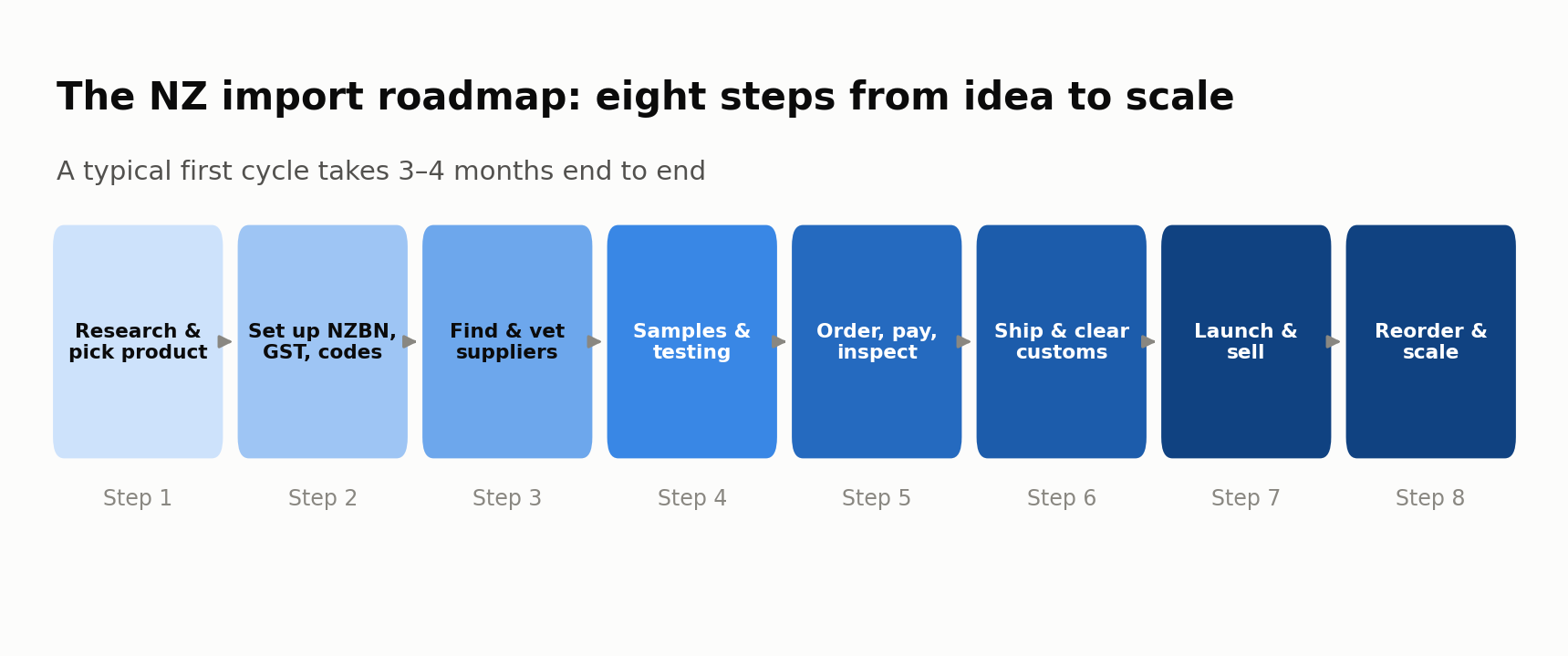
How to Start an Import Business in New Zealand in 2026: The Complete Roadmap
The complete 2026 roadmap for starting an import business in NZ — setup, sourcing, landed costs, customs and selling, step by step.
A 20-foot container shipped from China to Auckland costs roughly US$2,250–2,750 right now, and thanks to the NZ–China Free Trade Agreement, virtually everything inside it can enter New Zealand at 0% duty with the right paperwork. Most Kiwis never find that out, because they buy from a local wholesaler who did — and who keeps the margin.
That margin is the whole game. Our guiding maxim: margin is made in purchasing, not selling. Anyone can match your selling price on Trade Me next week. What they can't easily match is your buying price, if you've gone to the source — the factory — instead of buying from an importer three steps up the chain. This post is the full roadmap; the rest of this series unpacks each stage in detail.
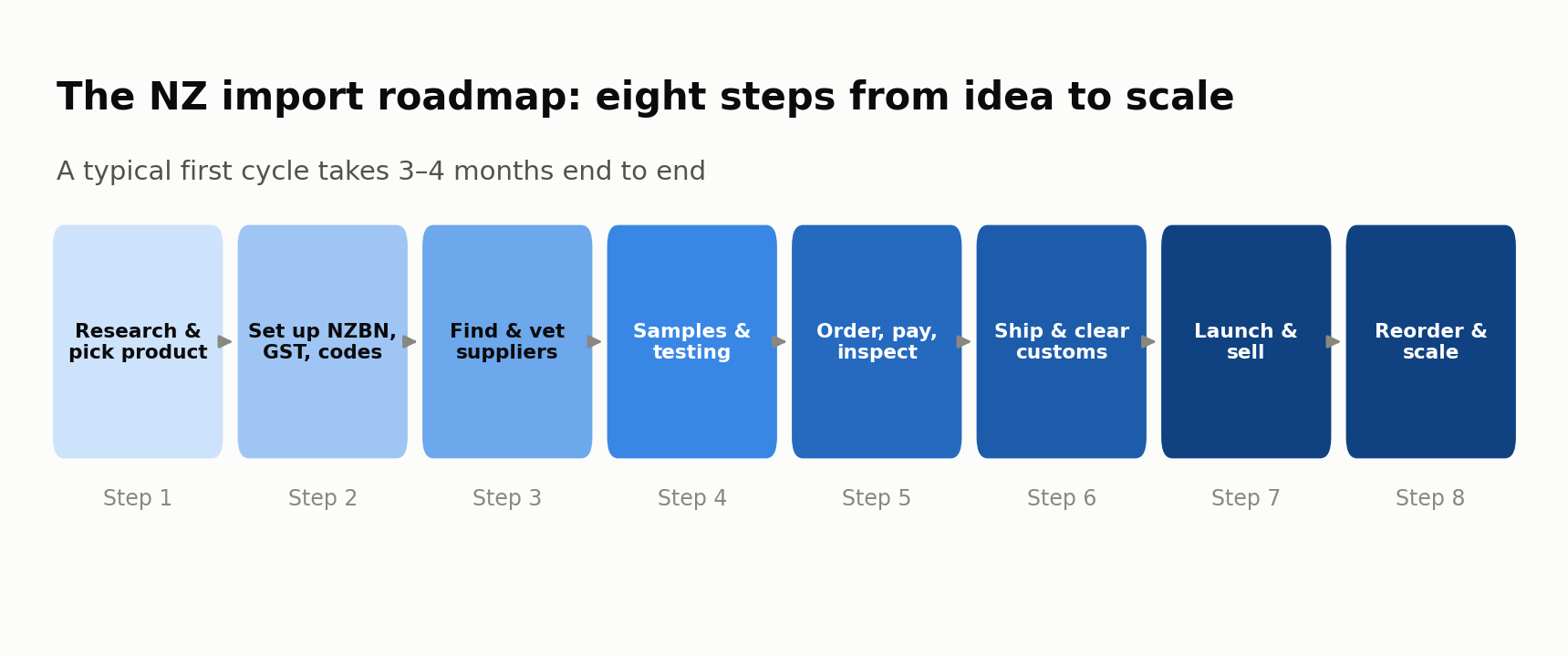
Figure: The import roadmap from business setup to first sale.
Stage 1: Set up the boring bits (one week)
You need three things before goods can move: an NZBN for your business, a decision on GST registration, and — for any shipment over NZ$1,000 — a Customs client code, applied for through Trade Single Window (TSW). GST registration is compulsory once your turnover passes NZ$60,000 in 12 months, but registering voluntarily earlier lets you claim back the 15% GST you'll pay on imports. We cover the exact process in a later post.
Stage 2: Choose a product with a real thesis
Don't start with whatever everyone else is selling. Pick a niche based on what you genuinely have: a social-media audience, a hobby you understand deeply, industry experience, or simply a well-researched shortlist. Check demand signals (Trade Me listings, Amazon best sellers, sales-estimation tools), and check the product isn't restricted or biosecurity-sensitive in NZ before you fall in love with it. Rule of thumb: to undercut an established branded product, you generally need to price at least 30% below it.
Stage 3: Find and vet suppliers
Alibaba and Global Sources put tens of thousands of manufacturers a message away, and both will even source suppliers for you free of charge. The hard part isn't finding suppliers — it's filtering out traders and scammers. Use platform verification filters, check ISO 9001 certification, demand a business licence, and never rely on a single supplier. Golden rule: if the price looks too good to be true, it is.
Stage 4: Samples, then a small first order
Order samples (expect to pay 20–50% over unit price, refundable against your first order — agree that up front). Test them hard: bend, stretch, use. Then negotiate a small trial order. Listed MOQs are almost always negotiable, and you should never pay more than 30% upfront — the unpaid 70% balance is your leverage for quality and on-time delivery.
Stage 5: Know your landed cost before you commit
Landed cost = product + freight + insurance + duty + GST + border levies + inspection + local costs. For most Chinese-origin goods with a Certificate of Origin, duty is 0% under the FTA; GST is 15% on (goods + shipping + insurance + any duty) and claimable if you're GST-registered. Since 1 April 2026, new consignment-based Goods Management Levies also apply at the border. If the numbers don't work on paper, they won't work in a container.
Stage 6: Ship, clear the border, and pass MPI
Use a freight forwarder and customs broker — never DIY container logistics. Budget realistic transit times: sea freight China→Auckland runs about 20–23 days port to port, and roughly 90 days total from placing a production order to stock in your warehouse. MPI biosecurity is the uniquely NZ hurdle: ISPM 15-treated pallets, clean containers, and extra scrutiny on timber, natural fibres and outdoor goods.
Stage 7: Sell — and diversify from day one
Trade Me is the obvious NZ starting channel, alongside your own Shopify store, Mighty Ape, Facebook Marketplace for testing, and Amazon Australia when you're ready to scale across the Tasman. Never build the business on one channel; platforms change rules without warning.
What it takes
A realistic minimum starting budget is around US$5,000 in product and costs — we break down the real numbers in an upcoming post. More important than money is process discipline: written specs, third-party inspections (about US$300 per order), and never paying 100% upfront. Beginners who follow the process outperform gamblers with triple the budget.
Key takeaways
- Margin is made in purchasing, not selling — buy at the source, not from local wholesalers.
- The NZ–China FTA gives 0% duty on virtually all Chinese-origin goods with a Certificate of Origin.
- Setup essentials: NZBN, a GST decision, and a Customs client code via TSW for shipments over NZ$1,000.
- Plan around 90 days from order to warehouse, and never pay a supplier 100% upfront.
Related: The 6-Step Import Process Every New Zealand Beginner Should Follow · How Much Money Do You Need to Start Importing to NZ? Real Numbers