
Landed Cost 101: The Formula That Decides Whether You Make Money
The landed-cost formula for NZ importers — every line item from FOB price to GST and levies, with a full worked example in real numbers.
Two importers buy the identical product at the identical US$10 FOB price. One makes 40% net margin; the other quietly loses money on every unit and doesn't discover it for six months. The difference is a single spreadsheet: the landed-cost calculation. It's the least glamorous document in importing and the most decisive — calculating your costs appropriately genuinely makes or breaks your import.
Landed cost = every dollar it takes to get one unit from the factory floor to your NZ warehouse, ready to sell. Not the supplier's price. Not the price plus freight. Everything.
The quick rule of thumb
For a low-duty destination like New Zealand, a useful first-pass estimate is supplier's FOB price + 20–30% ≈ landed cost. It's good enough for shortlisting ideas on your shopping list — and nowhere near good enough for a purchase order. Before real money moves, you build the full sheet and triple-confirm each line with the actual provider: forwarder, broker, insurer, platform.
Every line item, NZ edition
- Product cost (FOB): the supplier's quoted price, which under FOB terms includes delivery to the Chinese port. Include any export-packaging extras.
- Sea/air freight: mid-2026 indicative rates China→NZ: a 20ft container US$2,250–2,750; 40ft US$4,455–5,445; LCL around US$38/cbm; air freight about US$4.00/kg for larger lots; courier around US$6.71/kg door to door. Rates are volatile — quote, don't assume.
- Insurance: the standard is about 1% of product value. Cheap, and not the line to skip.
- Customs duty: 0% on virtually all Chinese-origin goods with a Certificate of Origin under the NZ–China FTA — make sure the supplier provides it. Otherwise most goods are duty-free anyway, with roughly 5–10% on categories like textiles, clothing and footwear. Confirm your HS code on tariff-finder.govt.nz.
- GST: 15%, calculated on (goods value + shipping + insurance + any duty). If you're GST-registered you claim it back — treat it as cash flow, not cost, but you still have to fund it at the border.
- Goods Management Levies: the new consignment-based border levies from 1 April 2026. Small on any one shipment, but per-consignment — one more reason to consolidate. Check customs.govt.nz for current rates on high-value entries.
- Broker and forwarder fees: customs entry lodgement, handling, documentation. Ask for the all-in quote.
- Inspection: ~US$300 for a third-party pre-shipment inspection. Non-negotiable on real orders.
- Testing and licence fees: lab testing where relevant (a few hundred US dollars), plus the fees suppliers never mention — Bluetooth licensing and Sisvel (MP3/MP4) royalties are the importer's cost, and skipping them risks customs holds or claims from licence holders.
- Domestic costs: transport from the port, storage, fulfilment, and your selling channel's fees when you calculate final profitability.
The worked example
Let's land 1,000 Bluetooth speakers in Auckland. FOB price US$10 each = US$10,000.
- Freight: ~3 cbm shipped LCL at ~US$38/cbm ≈ US$115 with minimums
- Insurance at 1% of product value: US$100
- Duty with NZCFTA Certificate of Origin: US$0
- Inspection: US$300
- Broker, entry and Goods Management Levy: allow roughly US$150 (confirm with your broker)
- Subtotal: ~US$10,665 — about US$10.67 per unit
- GST: 15% on (goods + shipping + insurance + duty) ≈ US$1,532 — funded at the border, claimed back if GST-registered
So a GST-registered importer's true landed cost is around US$10.67/unit — roughly FOB + 7%, well inside the rule of thumb, because this product is small, light and duty-free. Convert to NZ dollars at the day's rate, add local delivery and storage, then selling costs: on a marketplace, budget several percent for fulfilment and payment fees. If that unit retails at, say, NZ$49–59 in NZ, the margin story is obvious — and it was visible before ordering, which is the entire point.

Now rerun the same sheet for a bulky item — a US$20 product at 0.1 cbm each — and watch freight alone add US$3.80+ per unit before GST. Same formula, opposite verdict. That's the formula doing its job: killing bad products on paper instead of in your garage.
One sheet per product, forever
Make the landed-cost sheet a permanent habit: one per product, updated with actual invoiced figures once the shipment lands, so every reorder starts from real numbers rather than estimates. Costs drift — freight moves ~19% in a month during 2026, suppliers nudge prices, levies get reviewed — and your sheet is where drift becomes visible before it becomes losses.
Key takeaways
- Landed cost = FOB + freight + insurance + duty + GST + levies + fees + inspection — every line, triple-confirmed with the actual provider.
- FOB + 20–30% is a shortlist estimate only; for NZ with FTA duty at 0%, small light products often land far below that.
- GST (15% on goods + shipping + insurance + duty) is claimable if registered — cash flow, not cost, but budget to fund it.
- Watch the silent killers: freight on bulky items, licence royalties, and per-consignment levies on fragmented shipments.
Related: How Much Money Do You Need to Start Importing to NZ? Real Numbers, NZ Import Duty and the China FTA: How a Certificate of Origin Saves You Money
Validate Before You Buy: Testing Product Demand Without Spending a Dollar
How to test demand for an import product before ordering — free validation checks, NZ market signals, and the failure story that proves why.
A margin of US$39 per unit collapsed to US$1.50. That's what happened to an entrepreneur who built a genuinely good portable speaker, priced it under the big brands, and skipped proper validation. He discovered too late that five-plus big brands already owned the niche and buyers wanted brands, not bargains; that retailers were launching lookalikes with bigger marketing budgets; that shipping his heavy product actually cost US$50–60 a unit; and that plug compatibility added another US$10. His crowdfunding campaign reached 6% of target. Every one of those discoveries was available for free, before he spent a cent — he just didn't go looking.
Validation is the unglamorous step between "great idea" and "purchase order". Here's how to do it without spending a dollar.
Check the demand signals
You're trying to answer one question: do enough people already buy this, at a price that leaves you margin?
- Amazon and eBay: use best-seller ranks and review counts as a proxy for volume. Hundreds of recent reviews = proven demand (and proven competition). A free look with a tool like Jungle Scout's estimates sharpens the picture.
- Trade Me: search your product. How many listings? How do "sold" prices compare with what you'd need to charge? A category with steady sales and only tired, badly photographed listings is an opportunity; forty sharp sellers is a warning.
- Google Trends: is interest rising, seasonal, or dying? NZ-filtered data is thin for small niches, so check Australia and worldwide too — trends reach us on a lag, which works in your favour.
- Social hashtags: search the product on Instagram and TikTok. Post volume, engagement and growth tell you whether a wave is building or has broken.
Check the competition honestly
Confirm few or no NZ sellers carry the product — and if some do, that you can be meaningfully different (quality, bundle, packaging, service), not just marginally cheaper. Remember the benchmark from earlier in this series: against an established branded product you generally need to be at least 30% cheaper to pull buyers. And watch for the speaker trap: in brand-loyal categories, price barely matters at all. If the top players are household names, be somewhere else.
Ask real people — carefully
Float the idea in forums and Facebook groups where your target customers gather — NZ buy/sell groups, hobby communities, subreddit niches — without revealing so much that you hand the idea to a competitor. Ask about problems, not products: "what annoys you about X?" surfaces demand and improvement ideas at once. If you have any social following, tease the product and count genuine "where can I buy this?" replies. One importer built 8,000 followers in two months before launch and turned that audience into roughly 100 sales in week one — the validation and the launch marketing were the same activity.
Run the numbers before the order, not after
The speaker failure was a costing failure as much as a demand one. Before any money moves, build the landed-cost picture: manufacturing price, freight (deadly on heavy or bulky items), insurance, duty (0% for most Chinese-origin goods with a Certificate of Origin), 15% GST, border levies, selling fees — and the sneaky extras like licence royalties or country-specific adaptations. Then triple-confirm each figure with the actual provider: the forwarder for freight, the broker for border costs, the platform for fees. Estimates compound; one "roughly" per line item and your margin is fiction.
The (nearly) free physical test
Strictly-zero-dollar validation gets you a long way, but if a product survives every check above, there's a cheap final exam: order a handful of units — via a sample order or a small AliExpress purchase — and list them on Trade Me and Facebook Marketplace at your intended price. Real listings, real buyers, real objections. Selling five units at full price teaches you more than fifty spreadsheet rows: which photos work, what questions buyers ask, whether the price holds. If the test units sell easily, you order with confidence. If they sit there, you've just saved yourself a NZ$8,000 lesson for the price of a takeaway.
Kill ideas cheerfully
The goal of validation isn't to confirm your idea — it's to try to kill it. Most ideas should die at this stage; that's the system working. Your shopping-list spreadsheet has more candidates, and the discipline of killing weak ideas cheaply is exactly what lets you bet properly on the strong one that survives.
Key takeaways
- Validate demand free: marketplace ranks and reviews, Trade Me sold prices, Google Trends, and social hashtags.
- Check competition honestly — you need ~30% under a branded rival, and brand-loyal niches are unwinnable on price.
- Triple-confirm every cost line with the actual provider before ordering; estimates killed the speaker launch.
- Finish with a tiny real-world test on Trade Me or Facebook Marketplace before committing to a production order.
Related: How to Find the Right Product to Import: A Practical Framework, Landed Cost 101: The Formula That Decides Whether You Make Money

Products You Should NOT Import into New Zealand (and Why)
The product categories NZ beginners should avoid — licensed goods, biosecurity risks, anti-dumping items, patent copies and margin killers.
A pallet of garden furniture sits in a transitional facility in Auckland while MPI decides whether the untreated wooden packaging gets fumigated or destroyed — at the importer's expense, either way. The product was fine; the category choice was the mistake. Knowing what not to import is worth as much as any winning product idea, so before you fall in love with something on Alibaba, run it against this list.
Licensed and regulated categories: leave them alone
Some categories demand licences, registrations or approvals that are genuinely hard for a beginner to obtain — and getting it wrong isn't a slap on the wrist, it's seized goods:
- Foods, drinks and supplements
- Anything gas-related
- Vehicles
- Animals and animal products
- Weapons and firearms-related items
- Hazardous materials and chemicals
Could you eventually import protein powder compliantly? Perhaps. Should your first import be a product where MPI, food-safety rules and labelling law all apply at once? No. There are thousands of products where the compliance burden is a fraction of this.
Biosecurity-sensitive goods: MPI will find them
New Zealand's biosecurity regime is among the strictest on earth, and MPI has the power to inspect, treat, hold, destroy or order re-export of risky goods — with the bill landed on you. High-risk categories include timber and wooden furniture, natural fibres, outdoor and garden products, gym equipment with rubber or plant-based padding, stone and clay items, anything contaminated with soil, and used goods of almost any kind (which attract heavy scrutiny). These aren't banned — plenty of established importers handle them profitably — but they demand Import Health Standard checks on mpi.govt.nz before ordering, and they're a poor place to learn. And regardless of product: any wooden pallets or crates must be ISPM 15 treated and stamped, or your whole consignment inherits the problem.
Anti-dumping and high-duty items: the maths is rigged against you
Most goods enter NZ duty-free, and Chinese-origin goods are almost all 0% under the FTA — but not everything. Selected categories such as textiles, clothing and footwear still carry duty around 5–10%, and anti-dumping duties exist on certain products (MBIE's trade remedies list is the place to check). Internationally, the recurring anti-dumping families are batteries, solar components and steel products. The rule is simple: a punitive rate either kills your margin outright or signals a protected local industry with more lawyers than you. Check the Working Tariff Document and tariff-finder.govt.nz before committing — if the rate is ugly, move on.
Copies and patent-infringing products: the supplier's fairy tale
"Don't worry, we changed the design a bit." You will hear this, and it is false comfort: slightly modifying a patented or registered design does not clear it. The cautionary tale is the flood of bladeless-fan copies that hit the market after Dyson's original — retailers who stocked them paid fines, pulled stock, and were named in the press, while the factories that supplied them vanished from the conversation. As the importer of record, the liability is yours, not the supplier's. Branded fakes are even worse — that's not importing, it's an offence. Genuinely different components and function are generally safe; for anything serious, a patent search is cheaper than a lawsuit.
Margin killers: legal, but a bad idea
- Big, heavy, low-value items. Washing machines, furniture, large appliances: freight is charged on volume and weight, and a US$20 product occupying half a cubic metre never recovers. Small, light, durable wins.
- Brand-dominated categories. In some niches — premium audio is the classic — buyers want the brand and barely look at price. We've seen a genuinely good independent speaker die in exactly this trap. If the category's buyers are logo-loyal, your 30%-cheaper product still loses.
- Fragile and returns-prone goods. Under NZ consumer law, when the manufacturer has no NZ presence, the importer effectively carries the manufacturer's obligations. A 10% breakage rate is your problem, in your margin, on your doorstep.
- Electrical and wireless products — until you're ready. Not forbidden, but mains-powered goods fall under NZ electrical safety regulations (declared articles need a supplier declaration of conformity) and anything with Bluetooth or Wi-Fi needs Radio Spectrum Management compliance. Also note lithium batteries bring shipping restrictions — some couriers won't even airfreight your samples. Do these categories deliberately, later, with budget for compliance — not as a first product.
The five-minute pre-check that saves thousands
Before shortlisting any product: HS code on tariff-finder.govt.nz (duty and anti-dumping), Import Health Standards on mpi.govt.nz (biosecurity), Product Safety Standards under the Fair Trading Act (toys, cots, bikes and others have mandatory standards), and a quick patent/brand sanity check. Five minutes per product. Do it before the supplier conversation, not after the deposit.
Key takeaways
- Avoid licensed categories (food, supplements, gas, weapons) and used or plant/soil-associated goods as a beginner.
- Check tariff-finder.govt.nz and MBIE trade remedies — anti-dumping or high-duty items are automatic passes.
- "We changed the patented design a bit" is a fairy tale; as importer of record, the liability is yours.
- Skip heavy low-value goods, logo-loyal categories and electrical/wireless products until you're resourced for them.
Related: MPI Biosecurity: Getting Through the NZ Border Without Nasty Surprises, NZ Product Compliance: Electrical, Wireless, Toys and Safety Standards

12 Places to Find Winning Product Ideas Before Anyone Else in NZ
Twelve practical sources of import product ideas — from Kickstarter and Taobao to trade-fair exhibitor lists — before they reach NZ shelves.
A Danish gadget was funding wildly on Kickstarter while a single seller had a near-identical unit on Amazon for US$149 — and the same product sat on Alibaba with an estimated manufacturing cost under US$10. Whoever spotted that gap first didn't need genius; they needed a habit of looking in the right places. New Zealand's distance is actually an advantage here: trends often land on our shelves months after they've peaked overseas, which means a Kiwi importer watching the right sources sees products coming before local competitors do.
Here are the twelve places we keep watching, roughly in order of effort.
The armchair sources
1. Amazon Best Sellers. Free, updated hourly, sliced by category. You're not looking to copy the top item — that ship has sailed — you're reading which categories are heating up and what customer reviews complain about (every complaint is an improvement idea).
2. eBay trend signals. Watch what's suddenly selling in volume, but treat it as a signal, not a shopping list — the saturated majority is exactly what you don't copy.
3. Trade Me itself. Study what's listed heavily, what sells fast, and — more usefully — what NZ buyers clearly want but can only get via slow overseas shipping. That gap is your local opening.
4. Kickstarter and crowdfunding sites. Products funding on Kickstarter usually aren't on Amazon (or in NZ) yet — a genuine window to source a similar (non-infringing) product, improve it, and launch while the category is fresh. The US$149-listing example above came from exactly this watch.
5. 100+ niche newsletters. Subscribe to gadget and trend sites — The Gadget Flow, Engadget, Wired, CNET, PCMag and dozens of smaller ones — using a separate email address created just for this. Product ideas get delivered to you daily, free.
6. Kadaza. A curated directory of the top websites per category — the fastest way to find the trend blogs for whatever niche you're exploring, from home gadgets to pet gear.
The supplier-side sources
7. Global Sources e-magazines and Top Products. Free monthly sourcing e-magazines with hand-picked suppliers and trending products per category — you're seeing what factories are pushing before it reaches Western marketplaces. Alibaba's curated selection pages serve the same purpose.
8. Taobao. China's giant domestic marketplace. Run it through auto-translate and browse: products made for Chinese consumers are frequently tomorrow's Western trend — bubble tea was visible in Asia years before it exploded elsewhere. Almost no NZ competitor is looking here.
9. Trade fairs — even from your couch. The Canton Fair and the Hong Kong shows are the single most efficient idea source if you can travel (a trip can pay for itself), with peak editions in April and October. Can't fly? Every fair publishes a full exhibitor list online — mine it for products and supplier contacts without leaving Tauranga.
The real-world sources
10. Shops, malls and supermarkets. Photograph interesting products wherever you are — you're always working. What's in a Sydney or Singapore mall today may have zero NZ presence.
11. Travel. The classic: spot a product thriving in a foreign market that's absent at home. Every overseas holiday is a research trip if you keep your eyes open.
12. Research tools. When a candidate emerges, pressure-test it: Jungle Scout estimates Amazon sales volumes and fees via a browser extension; CashCowPro ranks the most profitable Amazon niches including factory cost and freight estimates. Amazon data isn't NZ data, but it's the best public proxy for product demand you'll find, and it's where you check whether a "winner" actually sells.
Turning sightings into a shortlist
Ideas are cheap; the system matters. Keep one running spreadsheet — photo, source link, estimated factory price, target NZ price, rough margin, notes — and add everything that passes the sniff test. Once a fortnight, rank the list and take the top one or two ideas into proper validation: demand checks, competition checks, and the landed-cost maths we cover later in this series. Then check the boring-but-vital stuff early — NZ regulations, biosecurity sensitivity, and whether the thing is small and light enough to freight economically.
Do this for three months and you'll have a deeper product pipeline than most established NZ importers, who mostly reorder what they sold last year.
Key takeaways
- Watch overseas sources — Kickstarter, Amazon, Taobao, supplier e-magazines — because trends reach NZ late, and that lag is your window.
- Free beats paid at the idea stage: newsletters, exhibitor lists and best-seller pages cost nothing.
- Use tools like Jungle Scout to check that an idea actually sells before you spend a dollar.
- Funnel everything into one shopping-list spreadsheet and validate only the top-ranked ideas.
Related: How to Find the Right Product to Import: A Practical Framework, Validate Before You Buy: Testing Product Demand Without Spending a Dollar

How to Find the Right Product to Import: A Practical Framework
A practical framework for choosing your first import product — match the niche to your own advantages, then apply hard filter rules.
The most expensive sentence in importing is "this product sells really well for other people." Chasing what's already saturated is the classic first-timer move: you arrive last, with the least buying power, into a market where a dozen NZ sellers already offer the identical item — and the only lever left is price. There's a better way to choose, and it starts with an honest look at yourself rather than at best-seller lists.
Start with your situation, not the product
The right first product is different for different people. Work out which of these scenarios is yours:
- You have money but no idea. Capital doesn't excuse you from needing a product thesis. Slow down; work the research process like everyone else. A funded gamble is still a gamble.
- You're on a tight budget. Good news: you're at the same starting line as everyone else. Even a first product that isn't a killer usually returns the investment and teaches you the entire process — which is worth more than the margin.
- You have a social-media following. This is a genuine unfair advantage. Pick a product that fits the audience: 50,000 fitness or outdoors followers points at yoga mats, gym accessories, drink bottles, backpacks, camping gear. One importer we know built 8,000 followers across platforms in two months before launch and sold around 100 units in the first week from social alone. Then extend the range within the same audience — yoga mat buyers want more exercise gear, not a vacuum cleaner.
- You have a passion category. If you live and breathe fishing, coffee or cycling, you already know what a better product looks like and what to tell the supplier to improve. That's product-development instinct money can't buy.
- You have industry experience. Sell what you can answer customer questions about. The ex-electrician importing tool accessories will out-serve a generalist every time.
- None of the above. Fine — build the list. Write down your interests, hobbies and household frustrations; subscribe to niche newsletters; collect ten or more product ideas; then research demand for each (Trade Me, Amazon, eBay, sales-estimation tools like Jungle Scout, and what local shops stock) and work down the list one by one.
Then apply the hard filters
Whatever the scenario spits out, every candidate product has to survive these filters:
- Regulation check first. Is it restricted, licensed or biosecurity-sensitive in NZ? Check the tariff position on tariff-finder.govt.nz and MPI's Import Health Standards before you fall in love with it. Anything electrical or wireless carries compliance obligations; foods, supplements and the like are a licensing minefield best left alone at the start.
- Logistics sanity. Transport can kill margin on heavy or bulky items — freight is charged on volume and weight, not value. A product that's small, light, durable and unbreakable is a beginner's best friend.
- Competition reality. If the majority already sells it, don't start there. And note a hard number: to pull buyers off an established branded product, you generally need to price at least 30% below it. If that 30% doesn't leave you margin, walk away.
- Brand-dominated categories. Some niches are price-insensitive because buyers want the brand — premium audio is a classic. We've watched a well-made, well-priced portable speaker fail because buyers in that category simply wanted the logo. Respect that.
- The margin maths. Estimate manufacturing cost, freight, duty (0% on most Chinese-origin goods under the FTA with a Certificate of Origin), 15% GST, levies, selling fees — then see what profit remains at a realistic NZ price. If it only works at an optimistic price, it doesn't work.
Differentiate — even a little
You don't need to invent something new. The most reliable path is a proven product made meaningfully better: a nicer colour range, a sensible accessory bundle, cleaner packaging, a properly written English manual, better internal components for a few cents more. These "boring" upgrades cost little, most can be negotiated on paper with the supplier before you ever order, and they're exactly what lifts you out of the identical-item price war. Being early matters too: find a product before it's everywhere in NZ and lock in a good supplier relationship, and later arrivals have to come through you or start from scratch.
Make it a system, not a moment
Product selection isn't a one-off decision — it's a habit. Keep a running "shopping list" spreadsheet of ideas with photos, links, target prices and rough margin notes. Add to it constantly; cull ruthlessly; take the top idea through validation (next in this series) before any money moves. Your second and third products will come off this list faster than your first.
Key takeaways
- Choose your niche from your own advantages — audience, passion, or industry knowledge — not from best-seller lists.
- Filter every idea: NZ regulations first, then logistics weight/bulk, competition, and honest margin maths.
- You need to price roughly 30% below an established branded rival to compete — if that kills margin, move on.
- Differentiate cheaply: colours, bundles, packaging and manuals beat inventing something new.
Related: 12 Places to Find Winning Product Ideas Before Anyone Else in NZ, Validate Before You Buy: Testing Product Demand Without Spending a Dollar

Setting Up Right: NZBN, GST Registration and Your Customs Client Code
The three pieces of admin every NZ importer needs — NZBN, the GST registration decision, and a Customs client code via TSW — explained simply.
Here's a mistake we see constantly: a first shipment worth NZ$4,000 arrives at Auckland, and only then does the importer discover they need a Customs client code to clear it — while storage charges tick up daily at the port. The whole setup that would have prevented it takes a few hours, costs almost nothing, and can be done from your couch. Let's get you sorted before your goods are on the water.
There are three pieces of admin that matter: your NZBN, your GST position, and your Customs client code. Take them in that order.
1. Get your NZBN (and choose your structure)
Every NZ business gets a New Zealand Business Number. If you register a company, an NZBN is issued automatically; sole traders can apply for one free. Which structure should you choose? That's a conversation for your accountant, but the practical import angle is this: a company keeps the business's liabilities separate from your personal assets, which matters more for importers than for many other businesses — under NZ consumer law, when the overseas manufacturer has no NZ presence, you effectively carry the manufacturer's responsibilities for the products you bring in. Start as you mean to continue: separate bank account, and every invoice, payment record and supplier email filed from day one. You will need that email from four months ago; everyone always does.
2. Make the GST decision deliberately
GST registration is compulsory once your turnover exceeds NZ$60,000 in any 12-month period. Below that, it's voluntary — and this is where importers differ from most small businesses. When your goods cross the border, Customs collects 15% GST calculated on the value of the goods plus shipping, insurance and any duty. If you're GST-registered, you claim that import GST back in your GST return. If you're not, it's simply a cost.
So should you register early? For most people planning a genuine import business: yes. On a NZ$10,000 landed shipment, that's roughly NZ$1,500 of GST back in your pocket rather than baked into your costs. The trade-offs: you must charge 15% GST on your NZ sales, and you take on filing obligations. If you're doing a one-off toe-dip with a few hundred dollars of stock, staying unregistered is defensible; if you're building a business, register.
One 2026 note: the new Goods Management Levies that replaced the old border fees from 1 April apply to all importers per consignment, GST-registered or not — even small low-value consignments attract a levy of a couple of dollars plus GST. There's no registration status that makes border levies disappear.
3. Get your Customs client code before you ship
For any consignment worth more than NZ$1,000, NZ Customs requires the importer to have a client code — a unique identifier for you or your company — and the shipment also needs a supplier code identifying the overseas supplier. You apply through Trade Single Window (TSW), Customs' online portal, and you'll need your NZBN and identification documents to hand. In practice, your customs broker can apply on your behalf and will usually sort the supplier code at the same time; if you have a broker lined up (you should — see our roadmap post), just ask them.
Do this before your first shipment leaves China, not when it lands. A missing client code doesn't stop goods arriving; it stops them clearing, and delays at the wharf cost real money.
The supporting cast
While you're in setup mode, three more things worth lining up:
- A customs broker and freight forwarder. The broker lodges your import entries through TSW; the forwarder moves the goods. Get both relationships established before you order.
- Accounting software that handles GST returns — reconciling import GST manually gets old fast.
- A document system. One folder per supplier (quotes, certificates, licences), one folder per order (PO, invoice, packing list, Bill of Lading, inspection report). Customs and IRD can both come asking; tidy importers have boring audits.
What this all costs
Almost nothing, which is why there's no excuse: NZBN registration is free, GST registration is free, the TSW client code application is free. Company incorporation costs a modest fee. Compare that with one day of container storage charges plus a rebooked delivery because your paperwork wasn't ready, and setup is the best-value work you'll do this month. For current specifics and forms, go straight to the sources: customs.govt.nz for client codes and levies, ird.govt.nz for GST, and business.govt.nz for structure guidance.
Key takeaways
- Get your NZBN, then decide GST registration deliberately — registered importers claim back the 15% import GST.
- GST registration is compulsory past NZ$60,000 turnover in 12 months; voluntary before that, and usually worthwhile for a real import business.
- Shipments over NZ$1,000 need a Customs client code (via TSW) and a supplier code — arrange them before goods ship, ideally through your broker.
- Set up document discipline from day one: one folder per supplier, one per order.
Related: NZ Customs Clearance Step by Step: TSW, Entries and Client Codes, GST on Imports: The $1,000 Threshold Explained for 2026

How Much Money Do You Need to Start Importing to NZ? Real Numbers
Real numbers for starting an NZ import business — what a sensible first budget looks like, where every dollar goes, and how to start smaller.
You don't need NZ$50,000 and a container. A sensible minimum to do this properly — real production order, inspection, freight, compliance and a buffer — is about US$5,000, which is somewhere in the NZ$8,000–9,000 range depending on the exchange rate on the day. You can test the waters with far less, and we'll show you how, but let's start with what a genuine first import actually costs, line by line.
The benchmark: what US$10,000 of product can return
First, why bother? Here's a worked benchmark we use often: an importer puts US$10,000 into 1,000 Bluetooth speakers at US$10 each. After freight, insurance and border costs, the landed cost comes to roughly US$13 a unit; add fulfilment and selling costs and you're all-in around US$16. At a US$49 retail price, that's a US$33 margin per unit — about US$33,000 gross profit potential on a US$10,000 product investment. Not every product performs like that, and selling 1,000 units takes real marketing work. But it shows why the maths of direct importing is worth learning: the margin is created at the buying stage.
Where a realistic first budget goes

Here's the anatomy of a ~US$5,000 starter budget for a compact, unregulated product:
- Product (50–60%): your actual order — say 300–500 units of something with a US$5–8 unit cost. This is the engine; everything else protects it.
- Samples (2–4%): expect to pay 20–50% above unit price per sample, plus courier. Always agree that sample costs are refunded against your first order.
- Freight and insurance (8–15%): LCL sea freight to Auckland runs around US$38/cbm in mid-2026; insurance is about 1% of product value. Small, dense products keep this tiny; bulky ones blow it out.
- Border costs: GST at 15% on (goods + shipping + insurance + any duty) — cash you front, but claimable if you're GST-registered. Duty is 0% on most Chinese-origin goods with a Certificate of Origin. Add the new consignment-based Goods Management Levies and your broker's clearance fee.
- Third-party inspection (~US$300): non-negotiable on any first order over ~US$2,000. It's the cheapest insurance in this industry.
- Compliance/testing (0–10%): product-dependent. A silicone kitchen gadget needs little; anything electrical or wireless needs proper attention (and budget) for NZ safety and radio-spectrum requirements.
- Buffer (10–15%): for the freight surcharge, the extra courier bill, the thing you didn't foresee. There's always a thing.
What's deliberately not in the budget: paying 100% upfront (never), air-freighting your main order (margins evaporate at up to 20x sea cost), and fancy branded packaging on order one — a neutral box with a logo sticker costs cents and does the job below roughly 500 units.
Can you start with less? Yes — here's the ladder
- Under NZ$500: buy 5–20 units of a product via AliExpress or similar and test demand on Trade Me or Facebook Marketplace. Prices run roughly 30% above true factory bulk cost, and quality is a lottery — but you're buying market data, not margin.
- NZ$1,000–3,000: a small trial production order. MOQs are almost always negotiable — the classic move is accepting a plain white box instead of a printed gift box, which can drop a 1,000-piece MOQ to around 200 pieces, because the 1,000 figure is usually a printing constraint, not a production one.
- NZ$8,000+: the full process — proper order, inspection, LCL shipment, real per-unit economics. This is where the benchmark maths above starts to apply.
Whatever the level, frame it to suppliers as "a first trial order — if successful, larger orders follow." It's true, and it gets you better terms.
The cash-flow reality nobody mentions
Your money is tied up for a while: 30% deposit at order, 70% on inspection pass, GST and levies at the border, and roughly 90 days from order to sellable stock. Then sales revenue trickles in over weeks or months. Budget for living with that cycle at least twice before the business self-funds — undercapitalisation kills more import ventures than bad products do.
Key takeaways
- A proper first import needs about US$5,000 (roughly NZ$8,000–9,000); a demand test needs under NZ$500.
- Product should be 50–60% of budget; never skip the ~US$300 inspection or the 10–15% buffer.
- Import GST (15%) is claimable if you're GST-registered — it's cash flow, not a true cost.
- Negotiate MOQs down (white-box trick), pay only 30% upfront, and keep enough cash for the 90-day cycle.
Related: Landed Cost 101: The Formula That Decides Whether You Make Money, Setting Up Right: NZBN, GST Registration and Your Customs Client Code
The 6-Step Import Process Every New Zealand Beginner Should Follow
The six-step process NZ importers should follow every time — from tariff checks to inspection — plus the real 90-day order timeline.
Roughly 90 days. That's how long it takes, on average, from placing a production order in China to having stock sitting in your New Zealand warehouse. Beginners who don't know that number promise customers stock "next month", plan a Christmas promotion in October, and learn the hard way. The 90 days is just one output of a repeatable six-step process — the same one we run every idea through, whether it's a NZ$2,000 trial or a full container.
Run every product through these six steps, in order. Skipping a step is where the expensive mistakes live.
Step 1: Check the regulatory ground first
Before anything else, find your product's Harmonized System (HS) tariff code — it determines duty rate, any restrictions, and whether anti-dumping duties apply. For NZ, check the Working Tariff Document and tariff-finder.govt.nz; the good news is most goods enter duty-free, and Chinese-origin goods are almost all 0% under the NZ–China FTA with a Certificate of Origin. While you're at it, check MPI's Import Health Standards for biosecurity requirements, and MBIE for any trade-remedy (anti-dumping) measures. Ten minutes here can save you from a product that's uneconomic or effectively blocked at the border.
Step 2: Find your product
Product selection deserves its own posts (and gets them later in this series), but the short version: pick a niche you have an edge in — audience, passion, or professional knowledge — and differentiate on quality, bundles, colours or packaging rather than copying whatever saturates Trade Me already.
Step 3: Find a supplier
The most exciting and the most difficult step. Alibaba and Global Sources are your main hunting grounds; both will even match you with vetted suppliers free of charge. Contact multiple suppliers — never rely on one — and filter hard: verified status, ISO 9001, plausible company profile, responsive communication. If a supplier's replies are slow and fragmented at enquiry stage, they'll be worse mid-order.
Step 4: Calculate all duties, taxes and costs
Build a landed-cost sheet before committing. Rule of thumb: supplier's FOB price plus 20–30% gets you close to landed cost in a low-duty country like NZ — but verify every line: freight, insurance (about 1% of product value), GST at 15% on (goods + shipping + insurance + any duty), the new Goods Management Levies, and forwarder and broker fees. If you're GST-registered, the import GST comes back to you. Triple-confirm each figure with the actual provider rather than guessing.
Step 5: Engage a freight forwarder and customs broker
Never DIY container logistics. A forwarder books the freight and handles documents; a broker lodges your customs entry through Trade Single Window. Your supplier will usually have forwarder contacts — get that quote as a benchmark, then compare with an NZ-based forwarder. Couriers (DHL, FedEx and friends) are for samples and small urgent lots only; at scale their volumetric pricing eats margin.
Step 6: Monitor the order and inspect before it ships
Small orders get deprioritised in factory queues, so check in weekly. Then, before the goods leave China, book a third-party pre-shipment inspection — around US$300. Time it for when about 80% of production is complete. If defects show up, the supplier will agree to rework — always — because you haven't paid the 70% balance yet. Which brings us to the iron rule that underpins the whole process: never pay 100% upfront. Thirty percent deposit, seventy percent after the inspection passes.
The 90-day timeline, broken down

Here's where the time actually goes on a standard sea-freight order:
- Order placement and admin clarification: ~5 days
- Raw material purchase by the factory: 20–30 days
- Production arrangement and queueing: ~10 days
- Production through to shipment: 5–10 days
- Sea transit to NZ: China→Auckland is around 20–23 days port to port; allow ~30 with handling
- Customs clearance, MPI checks and inland transport: 5–10 days
Plan promotions, cash flow and reorder points around this cycle. Reorders are faster — typically about half the original lead time, since the factory already holds your specs — but Chinese New Year and October's Golden Week can add weeks if you order at the wrong moment.
Key takeaways
- Always run the six steps in order: regulations → product → supplier → costs → logistics partners → monitoring and inspection.
- Check the HS code, tariff-finder.govt.nz and MPI requirements before you commit to any product.
- Budget ~90 days from production order to NZ warehouse, and plan promotions accordingly.
- Pay 30% deposit, inspect at 80% production for ~US$300, and release the 70% balance only when the report is clean.
Related: How to Start an Import Business in New Zealand in 2026: The Complete Roadmap, Landed Cost 101: The Formula That Decides Whether You Make Money
Why 2026 Is the Right Time for Kiwis to Start Importing
FTA duty at 0%, transparent new border levies and accessible freight rates — why 2026 stacks up well for new NZ importers.
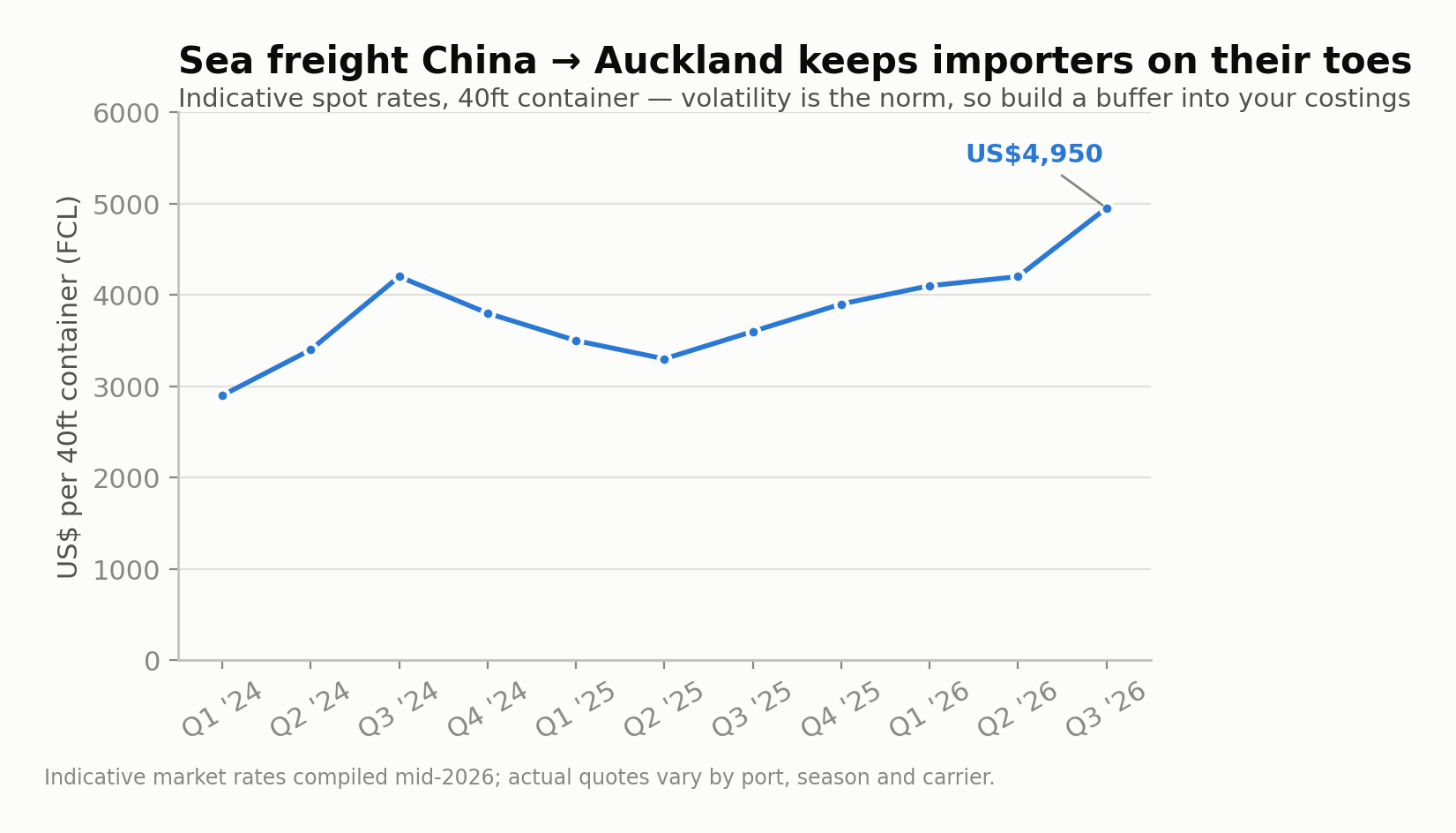
Sea freight from China to Auckland is sitting around US$2,250–2,750 for a 20-foot container in mid-2026, LCL space is going for roughly US$38 per cubic metre, and a certificate of paper — literally one document — takes the duty on most Chinese-origin goods to zero. If you've been waiting on the sidelines wondering when the conditions favour a first-time importer, this is what favourable looks like.
We're not going to pretend importing is a licence to print money. But several things have lined up in 2026 that genuinely lower the barrier for New Zealanders, and it's worth understanding each one.
Freight is affordable — but watch the volatility
The chart below shows why timing matters. Rates on the China–NZ trade lane have seen swings of around 19% month over month during 2026, which sounds alarming until you realise what it means in practice: per-unit freight on a well-chosen product is small enough that even a bad month rarely breaks the business case. Ship 1,000 compact units in three cubic metres of LCL at ~US$38/cbm and your freight bill is barely over US$100 — cents per unit.
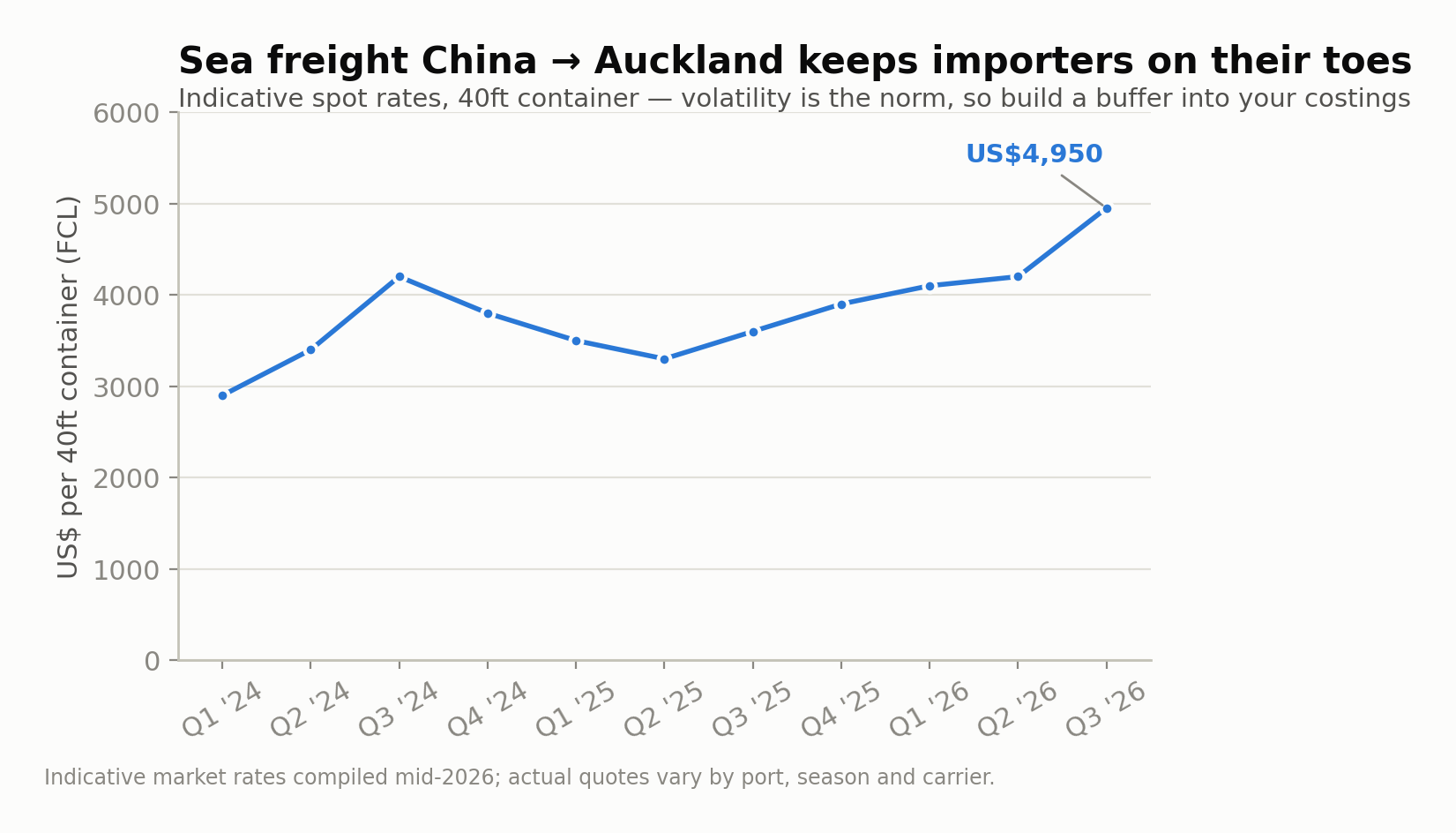
The lesson isn't "rates are cheap forever." It's that freight is now a manageable, quotable line item — get quotes from a forwarder before you order, and always benchmark against the quote from your supplier's own forwarder.
The China FTA does the heavy lifting
Under the NZ–China FTA, virtually all Chinese-origin goods enter New Zealand at 0% duty — you just need the supplier to provide a Certificate of Origin. Most other goods enter NZ duty-free anyway; only selected categories such as textiles, clothing, footwear and some processed foods carry duty of roughly 5–10%. Compare that with importers in protectionist markets who lose double-digit percentages at the border before they've sold a thing. Add the FTAs with ASEAN/Australia, CPTPP members, Korea, the UK and the EU, and NZ is one of the friendliest borders in the developed world for a small importer.
The new levies made border costs predictable
From 1 April 2026, the old Import Entry Transaction Fee and biosecurity levy were replaced by consignment-based Goods Management Levies. On low-value consignments (NZ$1,000 or less) you're looking at around NZ$2.21 by air or NZ$2.09 by sea per consignment, plus GST; higher-value consignments pay separate air/sea rates covering both Customs and MPI, invoiced per entry. Two practical consequences: first, border charges are now transparent and easy to model into a landed-cost sheet. Second, because charging is per consignment, consolidating orders into fewer, larger shipments now directly saves money — a habit that also gets you better freight rates.
Suppliers want small buyers like you
Fifteen years ago, factories courted container-load customers only. Today, Chinese suppliers are structurally open to small businesses and small quantities, and platforms make them searchable: Alibaba is the biggest database, and Global Sources offers verified suppliers, monthly sourcing e-magazines and even free supplier-matching services where you describe your product and they line up pre-screened factories. The infrastructure that once required a Hong Kong buying office now fits in your browser.
The NZ selling side has matured too
Trade Me remains the dominant local marketplace and a superb testing ground, but it's no longer the only route: your own Shopify store, Mighty Ape, Onceit for deal-driven volume, Facebook Marketplace for zero-cost demand testing, and Amazon Australia to reach across the Tasman once you've proven the product. Multiple channels mean you're not betting your business on one platform's rules.
The honest caveats
Nothing above removes the fundamentals: quality risk, communication barriers, ~90 days from order to warehouse, MPI biosecurity scrutiny, and the fact that as the importer you carry the manufacturer's obligations under NZ consumer law. Freight rates can spike; Chinese New Year still wipes out a month of production every summer (our summer, their winter). The importers who win in 2026 are the ones who treat those as process problems — inspections, buffers, paperwork — rather than surprises.
But that's precisely the point. The uncontrollable costs — duty, border fees, freight — have rarely been this low, this transparent, or this friendly to a first-timer with NZ$5,000–10,000 and a plan.
Key takeaways
- The NZ–China FTA takes duty on virtually all Chinese-origin goods to 0% with a Certificate of Origin.
- The April 2026 Goods Management Levies make border costs per consignment predictable — and reward consolidating shipments.
- Freight is a quotable, manageable line item in 2026, but rates are volatile — always get current quotes before ordering.
- Suppliers and platforms are structurally open to small first orders; the NZ selling side offers multiple channels beyond Trade Me.
Related: How to Start an Import Business in New Zealand in 2026: The Complete Roadmap, How Much Money Do You Need to Start Importing to NZ? Real Numbers