
Negotiation Tactics That Actually Work With Chinese Suppliers
The 20% counter, the double-quantity quote, 180-day price validity and more — field-tested tactics NZ importers can use in their next supplier email.
Take the supplier's quoted price, cut it by 20%, and send that back as your target. In roughly 80% of cases you won't get the full cut — but you will get a further reduction, typically around 5% off the original quote, simply because you asked in a structured way. That's the 20% counter, and it's the first move in a toolkit of tactics that work on real Chinese suppliers, in real email threads, without poisoning the relationship you'll depend on for years. Remember why this matters so much: margin is made in purchasing, not selling. Every dollar negotiated off your buy price drops straight to your bottom line.
The core price tactics
The 20% counter. As above. Quote received, minus 20%, presented politely as your target price "to make this product work in the New Zealand market". Expect to land around 5% below the original quote. It fails mainly when quantities are genuinely tiny.
Trial-order framing. Never negotiate a first order as a one-off. "This is a trial order — if it succeeds, larger orders follow" reframes your small volume as the start of a pipeline, which is the only story that justifies a factory sharpening its pencil.
The double/triple-quantity quote. Ask for pricing at two to three times your intended volume to expose the supplier's real floor, then ask them to honour that price on your smaller starter order with the full quantity promised at reorder. Factories need lines running; this works in most cases.
The mixed calculation. Buying four SKUs from one supplier, but only one is price-sensitive against competitors? Push the sensitive item's price down and let the supplier claw some of it back across the other three. Your competitive product stays sharp; the supplier's total stays acceptable; everyone signs.
The competing offer. Present a cheaper rival quote and ask for at least parity. If you genuinely have one, send it. If you don't, you may claim one exists — around 10% cheaper is credible — and you're under no obligation to show it. Suppliers do exactly the same in reverse.
Advance raw-material purchase. Before a reorder, when commodity prices are low, offer this trade: the supplier buys raw material now at today's prices, and in exchange you get a better price than last order. They may ask for a written order confirmation first — that's reasonable.
Lock the price down
A negotiated price you can't hold is worthless. Always demand stated validity on quotes: 90 days is standard, so ask for 180. Big retail buyers get twelve months or more. Without validity in writing, the price can move between your quote to a customer and your purchase order to the factory — and that gap comes out of your margin. Get validity onto every quotation and into your purchase-order terms.
Once a relationship matures, add the annual bonus agreement: agree a yearly turnover target with, say, a 5% rebate off the next order when it's hit, stepping up for higher thresholds. These conversations barely work by email — they're for phone calls at minimum, and ideally for a factory visit, where suppliers who've promised "best price, best service" to your face find it very hard to walk that back.
The relationship is the strategy
Here's what separates negotiators who get one good deal from importers who get a decade of them: six rules — mutual benefit, respect, fairness, trust, support, help. Squeeze every last cent from a supplier and you'll win the spreadsheet and lose the war: your order goes to the back of the queue, quality gets quietly value-engineered, and when you need an urgent favour — a rushed reorder before Chinese New Year, a rework at no charge — nobody picks up. Suppliers prioritise customers who are profitable and easy to deal with. Be firm on numbers, generous on everything else.
The most elegant tactic of all is what we call inception: framing your request as the supplier's own opportunity. A factory once refused to fund the roughly US$8,000 audit a European retail customer required — until the conversation reframed it: this standard is the entry ticket to every big retailer in that market; invest and you open doors far beyond one customer, and we'll refer you. He paid for it himself. When you can make your ask their win, you stop negotiating and start collaborating.
One caution to finish: a suspiciously low price is not a victory. Suppliers don't sell below cost — an impossible price means substituted materials, skipped testing or a scam. Negotiate hard toward a fair price, not a fantasy one.
Key takeaways
- Open with the 20% counter and trial-order framing; expect around 5% off the original quote in most negotiations.
- Use the double-quantity quote to find the real price floor and the mixed calculation across multi-SKU orders.
- Demand 180-day price validity in writing — an unlocked price silently eats the margin you just negotiated.
- Play the long game: fair, respectful buyers get better prices, priority production and rescue favours; cent-squeezers get the back of the queue.
Related: MOQ Explained: How to Negotiate Smaller First Orders, Handling Supplier Price Increases Without Losing Your Margin

Trading Company or Factory? How to Tell Who You're Really Dealing With
Middlemen add 10–30% to your buy price. Learn the name trick, profile checks and video-call test that reveal whether your "factory" really makes anything.
"Ningbo Better Lighting Co." and "Zhejiang Ningbo Better Lighting Co." sound almost identical — but one is probably a trading company and the other probably owns a factory. That single naming detail has saved us from paying middleman margins more times than any other check. Margin is made in purchasing, not selling: every percentage point a hidden middleman skims off your buy price is profit you'll never get back at the selling end. Here's how to work out who you're really dealing with.
Why it matters (and when it doesn't)
A trading company buys from factories and resells to you with a margin on top — often the very markup you went direct to China to avoid. Worse, a trader has no control over production quality, timing or specifications; they're forwarding your emails to a factory you'll never meet.
But let's be fair: not all traders are villains. Many genuine factories don't hold an export licence and legitimately sell through an affiliated trading company that handles export documents for a small percentage. Some traders add real value — consolidating small orders, quality-checking, communicating in good English. The problem isn't traders existing; it's traders pretending to be manufacturers so they can charge factory-direct expectations at middleman prices. Your job is to know the truth, then decide.
The company-name convention
Chinese company registrations follow a pattern that leaks the answer. Trading companies typically register with their hometown city in the name; manufacturers tend to register with the province. So "Ningbo Better Lighting Co." (city) leans trader, while "Zhejiang Ningbo Better Lighting Co." (province first) leans manufacturer. It's a probability signal, not proof — but it tells you which follow-up questions to push hardest.
Profile checks that expose middlemen
- Category spread. A "factory" whose storefront sells LED torches, yoga mats, USB cables and garden furniture makes none of them. Real manufacturers are specialists — a factory is a building full of machines tooled for one product family.
- Management standards. Factories invest in ISO 9001 (and increasingly BSCI); traders almost never do. No standard listed → assume trader. Standard listed → request the certificate and check the company name and address on it match. A mismatch means they're showing you someone else's factory.
- Registered capital vs claimed turnover. 50,000 RMB registered capital claiming US$50M turnover doesn't add up. Neither does massive turnover with a staff of 15. A properly organised factory usually runs 200+ people across workers, sales, engineers and management.
- The business licence. Ask for a copy. Yes, it's in Chinese — but outright refusal to provide it is the tell, and the registered scope of business can be translated in seconds.
The tests a trader can't pass
Paper checks narrow the field; two active tests settle it.
The customised sample. Ask for a small modification to the product — a different colour, your logo moulded in, a spec tweak — and a sample of it. A factory controls its own line and can do this; a trader has to go begging to the real manufacturer, and the delay, cost and excuses give the game away.
The live factory video call. Ask your contact to video-call you from the production floor and walk the line while you watch. Manufacturers are proud to show off; middlemen suddenly have "no availability". Back it up with a phone call: ask about annual capacity, main customers, which machines they run, what their engineers are working on. Vague answers to concrete factory questions mean there's no factory.
One more trick from the negotiation table: if one supplier's quote is well above the others, show them the cheaper quotes and ask why. We've seen this produce the remarkably honest reply, "Actually, we are a trading company." Cheaper isn't automatically better, though — sometimes a higher price reflects better materials or genuine certifications, which is exactly why you ask rather than assume.
What to do with the answer
If they're a factory: proceed to full vetting, samples and negotiation. If they're a trader who admits it and adds value you need — export licence, consolidation, communication — you can still work with them, with eyes open and prices benchmarked against factory-direct quotes. If they're a trader who lied about being a factory: walk. Someone who deceives you about their own identity before the first order will not become more honest after your deposit lands.
For a New Zealand importer running orders from 10,000 km away, the supplier relationship is your entire supply chain. Knowing exactly who is on the other end of it isn't paranoia — it's the foundation everything else sits on.
Key takeaways
- City name = likely trader; province name = likely manufacturer. Use it to direct your questioning, not as final proof.
- Specialist product range, ISO 9001, plausible capital/turnover/headcount and a willingly shared business licence all point to a real factory.
- A customised sample plus a live video walk-through of the production line is the pairing no middleman can fake.
- An honest trading company with an export licence can be legitimate — a trader pretending to be a factory never is.
Related: How to Vet a Chinese Supplier Before Sending a Cent, Sourcing Agents: When to Use One, What They Cost, What to Expect

How to Vet a Chinese Supplier Before Sending a Cent
A practical vetting checklist for NZ importers: platform filters, certificate checks, the video-call test and the red flags that mean walk away.
The most expensive email a new importer ever sends is the one transferring a deposit to a supplier they never checked. From Auckland or Christchurch you can't drop in to see the factory, so your protection is a vetting process — a series of cheap, fast checks that scammers and fake factories can't pass. Run every prospective supplier through this before a single dollar leaves your account.
Start with the platform filters
On Alibaba, filter for Gold Supplier, Onsite Check and Assessed Supplier together. Each represents money and scrutiny a scammer won't invest in. On Global Sources, look at the verified data: exhibiting history and named customers. This first pass eliminates most of the worst candidates in thirty seconds. It can also exclude some genuine young factories, so if results are thin, relax one filter at a time — but tighten your later checks to compensate.
Read the profile like a detective
A supplier's own profile leaks the truth if you know where to look:
- Management standards. No ISO 9001 or BSCI listed? Skip them. If it is listed, ask for the certificate and check the company name and address on it match the supplier you're talking to. Middlemen don't invest in management standards.
- Category breadth. A "manufacturer" selling everything from kitchenware to power tools to phone cases is a trading company. Real factories are specialists.
- Numbers that don't add up. Registered capital of 50,000 RMB against claimed turnover of US$50 million is fantasy. Huge turnover with 15 staff is equally fishy.
- Scale and age. A well-organised factory typically runs 200+ employees — say 160 workers, 30 sales staff, 10 engineers, 10 managers. Factories younger than about five years deserve extra caution.
- The company-name convention. Trading companies usually register with their hometown in the name; manufacturers use the province. We cover this trick in detail in its own post.

Ask for the documents
Now move to active verification. Email the supplier and request: a copy of their business licence (it will be in Chinese — the refusal to send it is the signal, not the content); their factory standard certificates (ISO 9001 at minimum); which third-party test laboratories they use; factory photos or a company presentation; and their customer list and main export markets.
Two things to watch in the answers. First, be cautious if they only ever work with Chinese test and inspection companies — you want suppliers accustomed to international third-party scrutiny. Second, look at their markets. If they already supply Australia, the UK, Germany or the US, they've likely passed the audits and testing those markets demand, which is a strong proxy that they can meet New Zealand requirements too — things like an SDoC for declared electrical articles and Radio Spectrum Management compliance for wireless products. If they've never exported to a first-world market, expect to educate them at your own risk.
Send a short vendor profile form asking for production capacity, worker/engineer counts, main customers, certifications and turnover. Professional suppliers fill it in without fuss.
The killer test
Two checks are almost impossible for a middleman to fake. First, ask them to produce a customised sample — something they don't have sitting on a shelf. Second, ask for a video call where they walk you through the factory live. A genuine manufacturer will happily show off the production line; a trader will stall, excuse and deflect. Follow up with a phone call and grill them on customers, annual capacity and certifications. You're building a gut feeling as much as a file of evidence.
And watch the communication itself. If replies are slow, fragmented or ignore half your questions at the enquiry stage — when they're trying to win your business — it will be worse mid-order when they already have your deposit. Eliminate the weakest communicators early.
The walk-away triggers
Some findings end the conversation immediately: a demand for 100% payment up front (legitimate suppliers accept a 30% deposit or a letter of credit); prices dramatically below every other quote; odd payment requests such as a personal bank account or Western Union; certificates whose company details don't match. The golden rule is old but reliable — if it looks too good to be true, it is. There are thousands of suppliers; never be so invested in one that you ignore a red flag.
One nuance: "trading company" is not automatically a death sentence. Many genuine factories lack an export licence and legitimately sell through an affiliated trader who handles export paperwork for a small margin. The crime isn't being a trader — it's pretending to be a factory.
Key takeaways
- Stack the free platform filters first, then verify certificates, licences and customer lists yourself — matching names and addresses on every document.
- A customised sample plus a live factory video call is the test middlemen can't fake.
- Poor communication at enquiry stage only gets worse after you've paid — cut slow repliers early.
- 100% upfront payment demands, implausible prices and mismatched certificates are instant walk-away triggers.
Related: Trading Company or Factory? How to Tell Who You're Really Dealing With, Import Scams and Red Flags: How Kiwis Get Burned (and How Not To)
The 6-Step Import Process Every New Zealand Beginner Should Follow
The six-step process NZ importers should follow every time — from tariff checks to inspection — plus the real 90-day order timeline.
Roughly 90 days. That's how long it takes, on average, from placing a production order in China to having stock sitting in your New Zealand warehouse. Beginners who don't know that number promise customers stock "next month", plan a Christmas promotion in October, and learn the hard way. The 90 days is just one output of a repeatable six-step process — the same one we run every idea through, whether it's a NZ$2,000 trial or a full container.
Run every product through these six steps, in order. Skipping a step is where the expensive mistakes live.
Step 1: Check the regulatory ground first
Before anything else, find your product's Harmonized System (HS) tariff code — it determines duty rate, any restrictions, and whether anti-dumping duties apply. For NZ, check the Working Tariff Document and tariff-finder.govt.nz; the good news is most goods enter duty-free, and Chinese-origin goods are almost all 0% under the NZ–China FTA with a Certificate of Origin. While you're at it, check MPI's Import Health Standards for biosecurity requirements, and MBIE for any trade-remedy (anti-dumping) measures. Ten minutes here can save you from a product that's uneconomic or effectively blocked at the border.
Step 2: Find your product
Product selection deserves its own posts (and gets them later in this series), but the short version: pick a niche you have an edge in — audience, passion, or professional knowledge — and differentiate on quality, bundles, colours or packaging rather than copying whatever saturates Trade Me already.
Step 3: Find a supplier
The most exciting and the most difficult step. Alibaba and Global Sources are your main hunting grounds; both will even match you with vetted suppliers free of charge. Contact multiple suppliers — never rely on one — and filter hard: verified status, ISO 9001, plausible company profile, responsive communication. If a supplier's replies are slow and fragmented at enquiry stage, they'll be worse mid-order.
Step 4: Calculate all duties, taxes and costs
Build a landed-cost sheet before committing. Rule of thumb: supplier's FOB price plus 20–30% gets you close to landed cost in a low-duty country like NZ — but verify every line: freight, insurance (about 1% of product value), GST at 15% on (goods + shipping + insurance + any duty), the new Goods Management Levies, and forwarder and broker fees. If you're GST-registered, the import GST comes back to you. Triple-confirm each figure with the actual provider rather than guessing.
Step 5: Engage a freight forwarder and customs broker
Never DIY container logistics. A forwarder books the freight and handles documents; a broker lodges your customs entry through Trade Single Window. Your supplier will usually have forwarder contacts — get that quote as a benchmark, then compare with an NZ-based forwarder. Couriers (DHL, FedEx and friends) are for samples and small urgent lots only; at scale their volumetric pricing eats margin.
Step 6: Monitor the order and inspect before it ships
Small orders get deprioritised in factory queues, so check in weekly. Then, before the goods leave China, book a third-party pre-shipment inspection — around US$300. Time it for when about 80% of production is complete. If defects show up, the supplier will agree to rework — always — because you haven't paid the 70% balance yet. Which brings us to the iron rule that underpins the whole process: never pay 100% upfront. Thirty percent deposit, seventy percent after the inspection passes.
The 90-day timeline, broken down

Here's where the time actually goes on a standard sea-freight order:
- Order placement and admin clarification: ~5 days
- Raw material purchase by the factory: 20–30 days
- Production arrangement and queueing: ~10 days
- Production through to shipment: 5–10 days
- Sea transit to NZ: China→Auckland is around 20–23 days port to port; allow ~30 with handling
- Customs clearance, MPI checks and inland transport: 5–10 days
Plan promotions, cash flow and reorder points around this cycle. Reorders are faster — typically about half the original lead time, since the factory already holds your specs — but Chinese New Year and October's Golden Week can add weeks if you order at the wrong moment.
Key takeaways
- Always run the six steps in order: regulations → product → supplier → costs → logistics partners → monitoring and inspection.
- Check the HS code, tariff-finder.govt.nz and MPI requirements before you commit to any product.
- Budget ~90 days from production order to NZ warehouse, and plan promotions accordingly.
- Pay 30% deposit, inspect at 80% production for ~US$300, and release the 70% balance only when the report is clean.
Related: How to Start an Import Business in New Zealand in 2026: The Complete Roadmap, Landed Cost 101: The Formula That Decides Whether You Make Money
How to Start an Import Business in New Zealand in 2026: The Complete Roadmap
The complete 2026 roadmap for starting an import business in NZ — setup, sourcing, landed costs, customs and selling, step by step.
A 20-foot container shipped from China to Auckland costs roughly US$2,250–2,750 right now, and thanks to the NZ–China Free Trade Agreement, virtually everything inside it can enter New Zealand at 0% duty with the right paperwork. Most Kiwis never find that out, because they buy from a local wholesaler who did — and who keeps the margin.
That margin is the whole game. Our guiding maxim: margin is made in purchasing, not selling. Anyone can match your selling price on Trade Me next week. What they can't easily match is your buying price, if you've gone to the source — the factory — instead of buying from an importer three steps up the chain. This post is the full roadmap; the rest of this series unpacks each stage in detail.
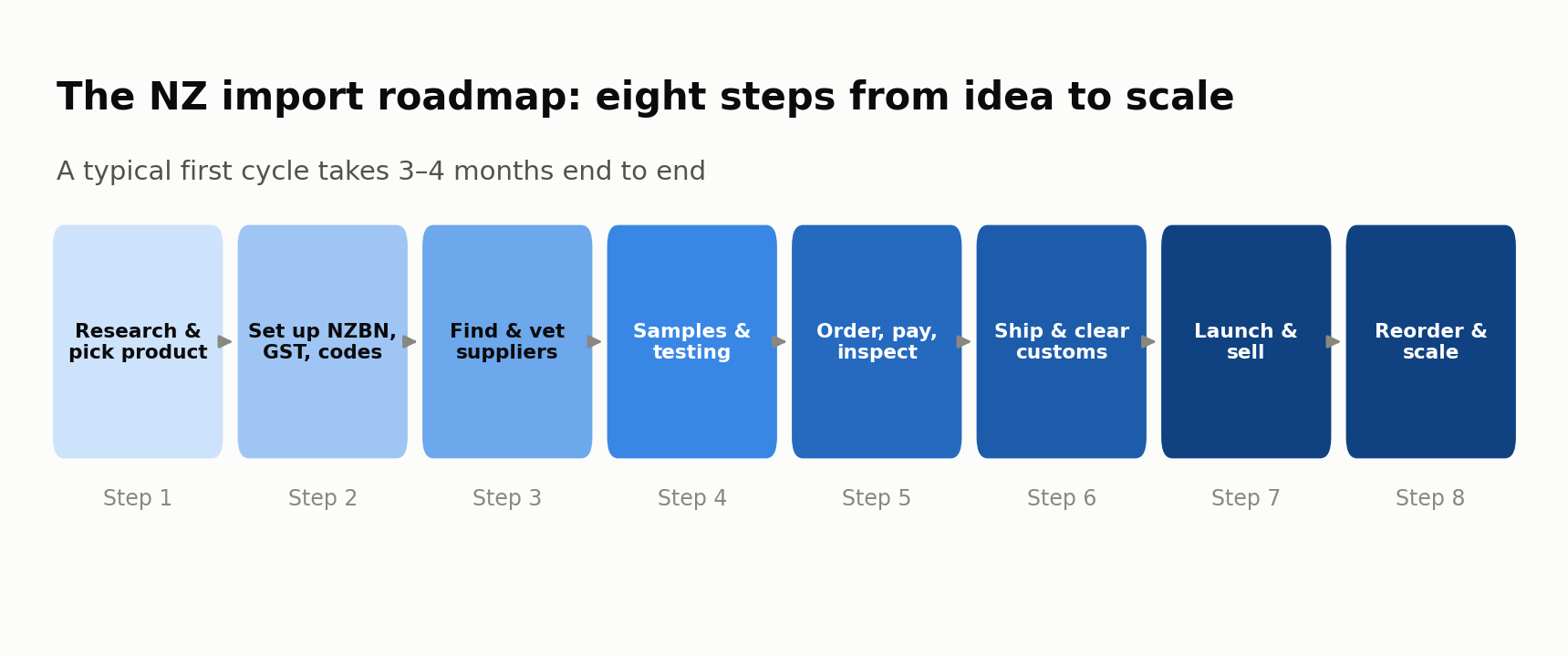
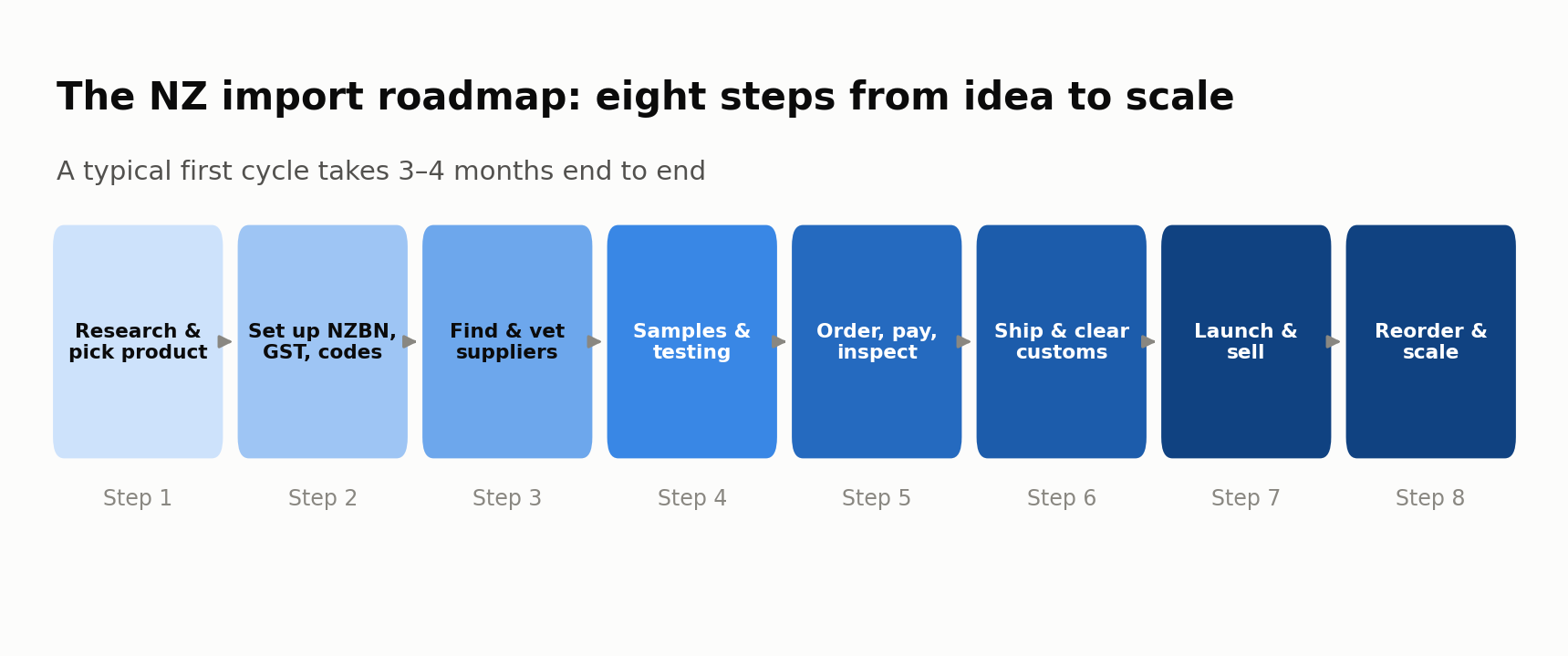
Figure: The import roadmap from business setup to first sale.
Stage 1: Set up the boring bits (one week)
You need three things before goods can move: an NZBN for your business, a decision on GST registration, and — for any shipment over NZ$1,000 — a Customs client code, applied for through Trade Single Window (TSW). GST registration is compulsory once your turnover passes NZ$60,000 in 12 months, but registering voluntarily earlier lets you claim back the 15% GST you'll pay on imports. We cover the exact process in a later post.
Stage 2: Choose a product with a real thesis
Don't start with whatever everyone else is selling. Pick a niche based on what you genuinely have: a social-media audience, a hobby you understand deeply, industry experience, or simply a well-researched shortlist. Check demand signals (Trade Me listings, Amazon best sellers, sales-estimation tools), and check the product isn't restricted or biosecurity-sensitive in NZ before you fall in love with it. Rule of thumb: to undercut an established branded product, you generally need to price at least 30% below it.
Stage 3: Find and vet suppliers
Alibaba and Global Sources put tens of thousands of manufacturers a message away, and both will even source suppliers for you free of charge. The hard part isn't finding suppliers — it's filtering out traders and scammers. Use platform verification filters, check ISO 9001 certification, demand a business licence, and never rely on a single supplier. Golden rule: if the price looks too good to be true, it is.
Stage 4: Samples, then a small first order
Order samples (expect to pay 20–50% over unit price, refundable against your first order — agree that up front). Test them hard: bend, stretch, use. Then negotiate a small trial order. Listed MOQs are almost always negotiable, and you should never pay more than 30% upfront — the unpaid 70% balance is your leverage for quality and on-time delivery.
Stage 5: Know your landed cost before you commit
Landed cost = product + freight + insurance + duty + GST + border levies + inspection + local costs. For most Chinese-origin goods with a Certificate of Origin, duty is 0% under the FTA; GST is 15% on (goods + shipping + insurance + any duty) and claimable if you're GST-registered. Since 1 April 2026, new consignment-based Goods Management Levies also apply at the border. If the numbers don't work on paper, they won't work in a container.
Stage 6: Ship, clear the border, and pass MPI
Use a freight forwarder and customs broker — never DIY container logistics. Budget realistic transit times: sea freight China→Auckland runs about 20–23 days port to port, and roughly 90 days total from placing a production order to stock in your warehouse. MPI biosecurity is the uniquely NZ hurdle: ISPM 15-treated pallets, clean containers, and extra scrutiny on timber, natural fibres and outdoor goods.
Stage 7: Sell — and diversify from day one
Trade Me is the obvious NZ starting channel, alongside your own Shopify store, Mighty Ape, Facebook Marketplace for testing, and Amazon Australia when you're ready to scale across the Tasman. Never build the business on one channel; platforms change rules without warning.
What it takes
A realistic minimum starting budget is around US$5,000 in product and costs — we break down the real numbers in an upcoming post. More important than money is process discipline: written specs, third-party inspections (about US$300 per order), and never paying 100% upfront. Beginners who follow the process outperform gamblers with triple the budget.
Key takeaways
- Margin is made in purchasing, not selling — buy at the source, not from local wholesalers.
- The NZ–China FTA gives 0% duty on virtually all Chinese-origin goods with a Certificate of Origin.
- Setup essentials: NZBN, a GST decision, and a Customs client code via TSW for shipments over NZ$1,000.
- Plan around 90 days from order to warehouse, and never pay a supplier 100% upfront.
Related: The 6-Step Import Process Every New Zealand Beginner Should Follow · How Much Money Do You Need to Start Importing to NZ? Real Numbers