
Landed Cost 101: The Formula That Decides Whether You Make Money
The landed-cost formula for NZ importers — every line item from FOB price to GST and levies, with a full worked example in real numbers.
Two importers buy the identical product at the identical US$10 FOB price. One makes 40% net margin; the other quietly loses money on every unit and doesn't discover it for six months. The difference is a single spreadsheet: the landed-cost calculation. It's the least glamorous document in importing and the most decisive — calculating your costs appropriately genuinely makes or breaks your import.
Landed cost = every dollar it takes to get one unit from the factory floor to your NZ warehouse, ready to sell. Not the supplier's price. Not the price plus freight. Everything.
The quick rule of thumb
For a low-duty destination like New Zealand, a useful first-pass estimate is supplier's FOB price + 20–30% ≈ landed cost. It's good enough for shortlisting ideas on your shopping list — and nowhere near good enough for a purchase order. Before real money moves, you build the full sheet and triple-confirm each line with the actual provider: forwarder, broker, insurer, platform.
Every line item, NZ edition
- Product cost (FOB): the supplier's quoted price, which under FOB terms includes delivery to the Chinese port. Include any export-packaging extras.
- Sea/air freight: mid-2026 indicative rates China→NZ: a 20ft container US$2,250–2,750; 40ft US$4,455–5,445; LCL around US$38/cbm; air freight about US$4.00/kg for larger lots; courier around US$6.71/kg door to door. Rates are volatile — quote, don't assume.
- Insurance: the standard is about 1% of product value. Cheap, and not the line to skip.
- Customs duty: 0% on virtually all Chinese-origin goods with a Certificate of Origin under the NZ–China FTA — make sure the supplier provides it. Otherwise most goods are duty-free anyway, with roughly 5–10% on categories like textiles, clothing and footwear. Confirm your HS code on tariff-finder.govt.nz.
- GST: 15%, calculated on (goods value + shipping + insurance + any duty). If you're GST-registered you claim it back — treat it as cash flow, not cost, but you still have to fund it at the border.
- Goods Management Levies: the new consignment-based border levies from 1 April 2026. Small on any one shipment, but per-consignment — one more reason to consolidate. Check customs.govt.nz for current rates on high-value entries.
- Broker and forwarder fees: customs entry lodgement, handling, documentation. Ask for the all-in quote.
- Inspection: ~US$300 for a third-party pre-shipment inspection. Non-negotiable on real orders.
- Testing and licence fees: lab testing where relevant (a few hundred US dollars), plus the fees suppliers never mention — Bluetooth licensing and Sisvel (MP3/MP4) royalties are the importer's cost, and skipping them risks customs holds or claims from licence holders.
- Domestic costs: transport from the port, storage, fulfilment, and your selling channel's fees when you calculate final profitability.
The worked example
Let's land 1,000 Bluetooth speakers in Auckland. FOB price US$10 each = US$10,000.
- Freight: ~3 cbm shipped LCL at ~US$38/cbm ≈ US$115 with minimums
- Insurance at 1% of product value: US$100
- Duty with NZCFTA Certificate of Origin: US$0
- Inspection: US$300
- Broker, entry and Goods Management Levy: allow roughly US$150 (confirm with your broker)
- Subtotal: ~US$10,665 — about US$10.67 per unit
- GST: 15% on (goods + shipping + insurance + duty) ≈ US$1,532 — funded at the border, claimed back if GST-registered
So a GST-registered importer's true landed cost is around US$10.67/unit — roughly FOB + 7%, well inside the rule of thumb, because this product is small, light and duty-free. Convert to NZ dollars at the day's rate, add local delivery and storage, then selling costs: on a marketplace, budget several percent for fulfilment and payment fees. If that unit retails at, say, NZ$49–59 in NZ, the margin story is obvious — and it was visible before ordering, which is the entire point.

Now rerun the same sheet for a bulky item — a US$20 product at 0.1 cbm each — and watch freight alone add US$3.80+ per unit before GST. Same formula, opposite verdict. That's the formula doing its job: killing bad products on paper instead of in your garage.
One sheet per product, forever
Make the landed-cost sheet a permanent habit: one per product, updated with actual invoiced figures once the shipment lands, so every reorder starts from real numbers rather than estimates. Costs drift — freight moves ~19% in a month during 2026, suppliers nudge prices, levies get reviewed — and your sheet is where drift becomes visible before it becomes losses.
Key takeaways
- Landed cost = FOB + freight + insurance + duty + GST + levies + fees + inspection — every line, triple-confirmed with the actual provider.
- FOB + 20–30% is a shortlist estimate only; for NZ with FTA duty at 0%, small light products often land far below that.
- GST (15% on goods + shipping + insurance + duty) is claimable if registered — cash flow, not cost, but budget to fund it.
- Watch the silent killers: freight on bulky items, licence royalties, and per-consignment levies on fragmented shipments.
Related: How Much Money Do You Need to Start Importing to NZ? Real Numbers, NZ Import Duty and the China FTA: How a Certificate of Origin Saves You Money
Why 2026 Is the Right Time for Kiwis to Start Importing
FTA duty at 0%, transparent new border levies and accessible freight rates — why 2026 stacks up well for new NZ importers.
Sea freight from China to Auckland is sitting around US$2,250–2,750 for a 20-foot container in mid-2026, LCL space is going for roughly US$38 per cubic metre, and a certificate of paper — literally one document — takes the duty on most Chinese-origin goods to zero. If you've been waiting on the sidelines wondering when the conditions favour a first-time importer, this is what favourable looks like.
We're not going to pretend importing is a licence to print money. But several things have lined up in 2026 that genuinely lower the barrier for New Zealanders, and it's worth understanding each one.
Freight is affordable — but watch the volatility
The chart below shows why timing matters. Rates on the China–NZ trade lane have seen swings of around 19% month over month during 2026, which sounds alarming until you realise what it means in practice: per-unit freight on a well-chosen product is small enough that even a bad month rarely breaks the business case. Ship 1,000 compact units in three cubic metres of LCL at ~US$38/cbm and your freight bill is barely over US$100 — cents per unit.
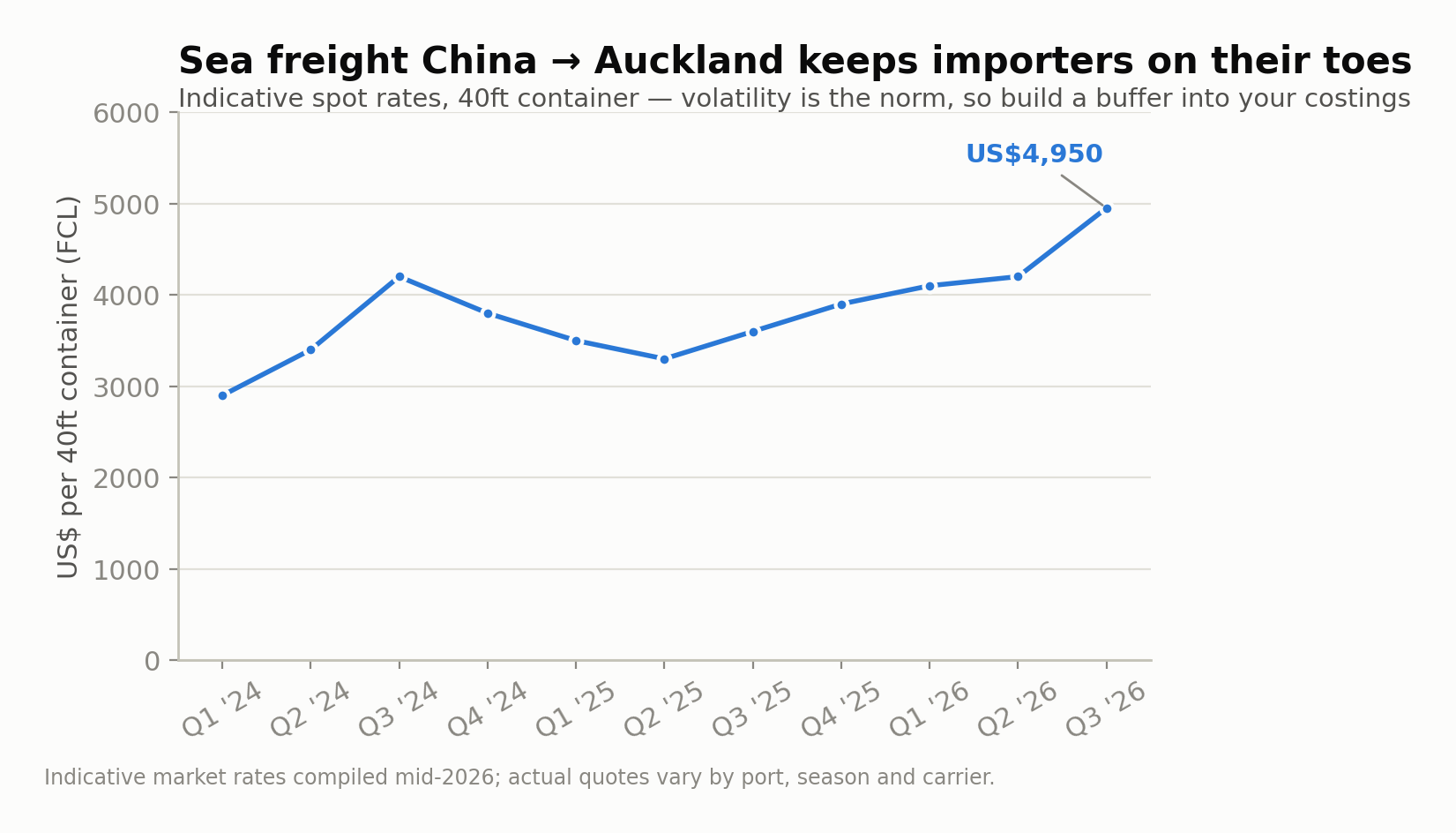
The lesson isn't "rates are cheap forever." It's that freight is now a manageable, quotable line item — get quotes from a forwarder before you order, and always benchmark against the quote from your supplier's own forwarder.
The China FTA does the heavy lifting
Under the NZ–China FTA, virtually all Chinese-origin goods enter New Zealand at 0% duty — you just need the supplier to provide a Certificate of Origin. Most other goods enter NZ duty-free anyway; only selected categories such as textiles, clothing, footwear and some processed foods carry duty of roughly 5–10%. Compare that with importers in protectionist markets who lose double-digit percentages at the border before they've sold a thing. Add the FTAs with ASEAN/Australia, CPTPP members, Korea, the UK and the EU, and NZ is one of the friendliest borders in the developed world for a small importer.
The new levies made border costs predictable
From 1 April 2026, the old Import Entry Transaction Fee and biosecurity levy were replaced by consignment-based Goods Management Levies. On low-value consignments (NZ$1,000 or less) you're looking at around NZ$2.21 by air or NZ$2.09 by sea per consignment, plus GST; higher-value consignments pay separate air/sea rates covering both Customs and MPI, invoiced per entry. Two practical consequences: first, border charges are now transparent and easy to model into a landed-cost sheet. Second, because charging is per consignment, consolidating orders into fewer, larger shipments now directly saves money — a habit that also gets you better freight rates.
Suppliers want small buyers like you
Fifteen years ago, factories courted container-load customers only. Today, Chinese suppliers are structurally open to small businesses and small quantities, and platforms make them searchable: Alibaba is the biggest database, and Global Sources offers verified suppliers, monthly sourcing e-magazines and even free supplier-matching services where you describe your product and they line up pre-screened factories. The infrastructure that once required a Hong Kong buying office now fits in your browser.
The NZ selling side has matured too
Trade Me remains the dominant local marketplace and a superb testing ground, but it's no longer the only route: your own Shopify store, Mighty Ape, Onceit for deal-driven volume, Facebook Marketplace for zero-cost demand testing, and Amazon Australia to reach across the Tasman once you've proven the product. Multiple channels mean you're not betting your business on one platform's rules.
The honest caveats
Nothing above removes the fundamentals: quality risk, communication barriers, ~90 days from order to warehouse, MPI biosecurity scrutiny, and the fact that as the importer you carry the manufacturer's obligations under NZ consumer law. Freight rates can spike; Chinese New Year still wipes out a month of production every summer (our summer, their winter). The importers who win in 2026 are the ones who treat those as process problems — inspections, buffers, paperwork — rather than surprises.
But that's precisely the point. The uncontrollable costs — duty, border fees, freight — have rarely been this low, this transparent, or this friendly to a first-timer with NZ$5,000–10,000 and a plan.
Key takeaways
- The NZ–China FTA takes duty on virtually all Chinese-origin goods to 0% with a Certificate of Origin.
- The April 2026 Goods Management Levies make border costs per consignment predictable — and reward consolidating shipments.
- Freight is a quotable, manageable line item in 2026, but rates are volatile — always get current quotes before ordering.
- Suppliers and platforms are structurally open to small first orders; the NZ selling side offers multiple channels beyond Trade Me.
Related: How to Start an Import Business in New Zealand in 2026: The Complete Roadmap, How Much Money Do You Need to Start Importing to NZ? Real Numbers